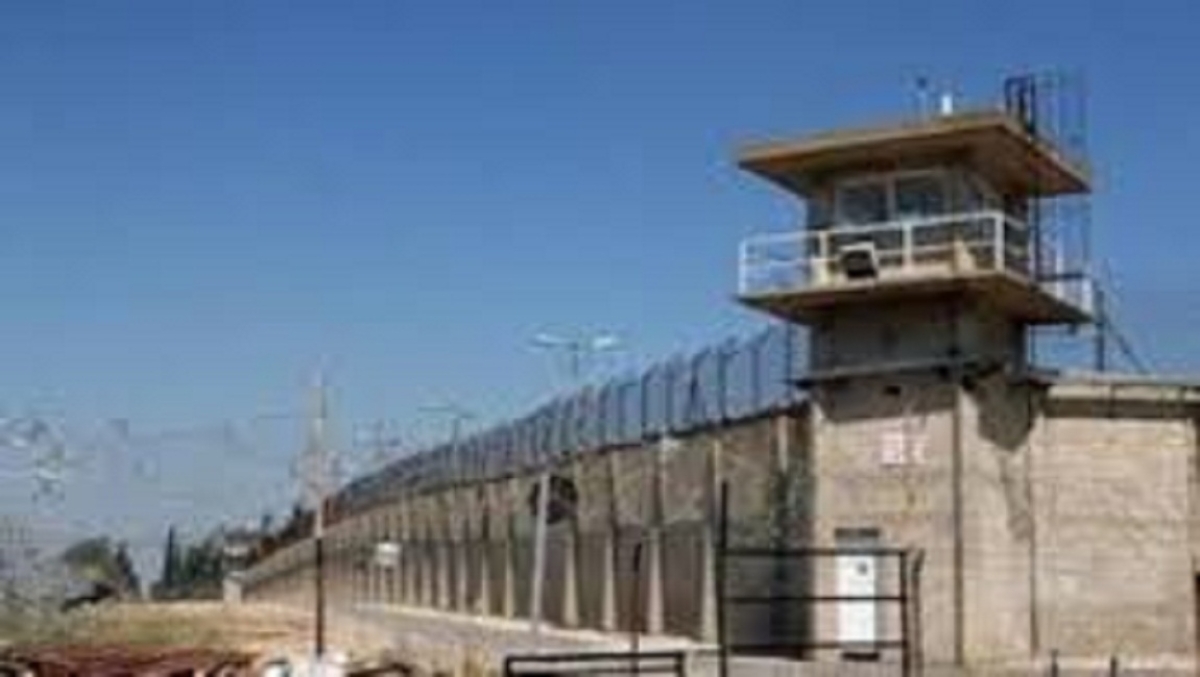
There are more than 700 sick detainees in Israeli jails
on . Posted in slider
The Commission of Detainees: this is how the administration of Israeli prisons execute detainees in deliberate systematic way
The Commission of Detainees and Ex-Detainees' Affairs confirmed that the administration of Israeli prisons is deliberately committing violations against sick and wounded detainees by neglecting their health conditions, pushing them to death.
The Commission pointed out that the level of health care provided for detainees is very poor, and many testimonies of detainees indicate that sick detainees are subjected to the worst health care ever in Israeli jails and detention centers.
The Commission also stressed that the treatment of sick detainees is an issue used by prisons' administration to bargain and practice pressure against them, which is considered a flagrant violation to articles (29, 30 and 31) of the Third Geneva Convention and articles (91 and 92) of the Forth Geneva Convention, which stipulates that sick detainees are entitled to the right to health and medical care and that they should be provided with the appropriate medicine and having periodic medical examinations.
The most prominent policies practiced by prisons' administration in a deliberate and systematic way to kill detainees:
• Sick detainees suffer from bad detention conditions represented in: Lack of ventilation, extreme humidity, overcrowding; spread of insects, as well as shortages of cleaning supplies and insecticide.
• Procrastinate in providing medical treatment and refraining from surgical treatment for sick detainees.
• All sick detainees are treated in the same way by taking painkillers.
• Lack of specialized doctors in prisons such as: ophthalmologists and dentists.
• Lack of doctor shifts at night to treat emergency cases.
• Lack of supervisors and psychotherapists; there are many psychological cases, which require special medical supervision, where there are more than 25 cases of mental disease.
• Lack of medical assistive devices for people with special needs.
• Not providing healthy meals for detainees that suit their illnesses such as diabetes, high blood pressure, heart diseases and others.
• Lack of isolation rooms for sick detainees with infectious diseases which leads to spread the disease.
• Transferring sick detainees to hospitals while being handcuffed, instead of transferring them in ambulance.
• Depriving detainees with chronic diseases of their medication as a means of punishment.
• Resort to torture and attack in dealing with sick detainees and use tear gas to suppress them.
• Punitive measures aggravate their health conditions, represented in procrastination in providing medical treatment and transferring to hospitals, depriving them of family visits and solitary confinement.
• The hospital of Al-Ramla prison lacks medical supplies, where detainees are treated with the same measures and cruel treatment as prison.
• Provide expired medications to sick detainees.
• Misusing the health condition of sick detainees in interrogating them by practicing pressure against them to force them confess guilt.
The Commission pointed out that the number of Captive Movement martyrs who died because of medical neglect since 1967 is (64), the last of which were the martyrs Fares Baroud from Gaza Strip and Nassar Taqatqa from Bethlehem, where the Israeli authorities still retaining their bodies.
The number of sick detainees in Israeli jails reached up to (700) male and female detainees, including (170) cases who have serious illnesses. (25) of them suffer from cancer, such as Bassam Sayeh and Sami Abu-Dyak. Moreover, there are (17) cases who are living permanently in the so-called Al-Ramla hospital, while tens of detainees suffer from disabilities, paralysis, kidney failure and heart diseases.
Occupation authorities arrested nearly (2800) Palestinians in the first half of 2019
on . Posted in slider
Ramallah: the occupation forces arrested (2759) Palestinians since the beginning of 2019 till June, 3 including (446) minors and (76) females.
Detainee's institutions and Human Rights organizations (the Commission of Detainees and Ex-detainees' Affairs, the Palestinian Society Prisoner's Club, Al Dameer Association for Human Rights) pointed out that the total number of detainees in Israeli jails is (5500), including (43) females, (220) minors and (500) administrative detainees.
The following is the most prominent policies and measures practiced by the occupation authorities in June:
The occupation authorities arrested (364) citizens in June, including: (160) from Jerusalem, (56) from Ramallah, (60) from Hebron, (31) from Jenin, (40) from Bethlehem, (25) from Nablus, (13) from Tulkarem, (9) from Qalqilai, (5) from Tubas, (5) from Salfit, (9) from Jericho and (7) from Gaza Strip.
Individual hunger strike, continues protest
Detainees in Israeli jails continued their protest against administrative detention by entering hunger strikes, noting that some of these detainees were able to have deals that determine the period of their detention.
Cases in point: Ihsan Othman,21, from Ramallah, Jafar Ezz-Aldeen, 48, from Jenin and other five detainees from Dura\ Hebron, including two siblings: Mahmoud Alfasfoos 29 years old, Kayed 30 years old, Ghadanfar Abu Atwan 26 years old, Abdulazeez Swaiti 30 years old and Saed Nammura 27 years old, and they ended their strike after 12 days.
Detainees' institutions pointed out that some of those have been sentenced to administrative detention at the same day of their release; a case in point is the detainee Jafar Ezz-Aldeen, who spent five years under administrative detention and entered hunger strike four times protesting against his administrative detention.
Prisons administration continued to impose Aggressive measures, represented in isolation, transferring to other prisons, deprivation of family visits and lawyer meetings, in addition to the procedures practiced by jailors against them.
Israeli occupation authorities have rearrested 17 persons and executed one during June
The Israeli authorities have rearrested 17 persons from Jerusalem, Ramallah, Hebron, Jenin, Salfit and Bethlehem, and executed the released detainee Muhammad Obaid from Jerusalem in June 2019.
The report showed that the Israeli authorities have executed the released detainee Muhammad Obaid in June 27, 2019, after shooting him from a zero distance, and procrastinated in handing his body.
The report also confirmed that targeting released detainees by re-arrest them and practice extrajudicial filed execution is part of a systematic and official Israeli policy in an attempt to practice pressure against the Captive Movement.
It is also pointed out that re-arresting released detainees will lead to unexpected circumstances in Israeli jails at any moment.
Occupation authorities detain the Egyptian-French detainee Salah Hasaneen in cruel conditions
on . Posted in slider
The Commission of Detainees and Ex-detainees' Affairs stated that the occupation authorities still detain the Egyptian-French Salah Muhammad Hasaneen, 61, in cruel conditions.
The Commission pointed out that the detainee Hasaneen is currently held in the so-called Al-Ramlah clinic in very difficult health conditions. He suffers from hemiplegia on the right side of his body and spinal problems. He moves using a wheelchair, but it was confiscated when he got detained and now he uses a normal chair. Moreover, he suffers from heart disease, diabetes and high blood pressure and he needs a special care.
The Commission also stated that occupation forces arrested Hasaneen from the courtyards of Al-Aqsa Mosque for feeble pretexts, where he got detained in Al-Maskoubya detention center and then moved to Raymon, Ofer and lately to Al-Ramlah clinic.
The Commission of Detainees condemned the assault of the occupation and its punitive measures which increase day by day. Arrests did not include only Palestinians, but also persons from other nationalities. This criminal policy comes in the context of targeting Al-Aqsa Mosque, in an attempt to prevent prayers from being there and deprive its visitors from practicing their religious duties.
Detainees institutions: occupation forces arrested (615) Palestinians in July 2019
on . Posted in slider
Ramallah: occupation forces arrested 615 citizens from the occupied Palestinian territories in July 2019, including 93 minors and 9 females.
Detainees' institutions and Human Rights Organizations (the Commission of Detainees and Ex-detainees' Affairs, the Palestinian Society Prisoner's Club, Al Dameer Association for Human Rights) pointed out that the occupation authorities arrested 266 citizens from Jerusalem, 76 from Ramallah, 75 from Hebron, 54 from Jenin, 33 from Bethlehem, 39 from Nablus, 17 from Tulkarem, 21 from Qalqylia, 7 from Tubas, 6 from Salfit, 8 from Jericho and 13 from Gaza Strip.
Thus, the number of detainees in Israeli jails becomes 5700, including 37 females, 230 minors and 500 administrative detainees, while 100 new administrative detention orders have been issued last month.
The most prominent policies and measures practiced by the occupation authorities in July:
The Martyr Nassar Taqatqa who was subjected to medical negligence, before being the martyr number 220
On July 16, 2019, the administration of occupation prisons announced the martyrdom of the detainee Nassar Majed Omar Taqatqa, 31, from Bethlehem in Nitzan Al-Ramlah prison.
Since the date of his arrest he was subjected to harsh interrogation and bad detention conditions by interrogators and jailors, in addition to frequent transfers at interrogation centers. He had serious deterioration on his health, according to testimonies of his fellow detainees.
According to information given to the detainees' institutions after his martyrdom, Taqatqa was exposed to torture and medical negligence during interrogation. At the beginning of his detention, he was held at Al-Maskoubya interrogation center, and then he got transferred Jalamah prison and then to Megiddo prison, where he got beaten by jailors.
According to the results of the autopsy conducted for the body of the martyr Taqatqa, the direct cause of death has been shown to be caused by acute pneumonia. This confirms that he was subjected to medical negligence, deprivation of proper treatment and difficult conditions during interrogation. He martyred facing his disease alone in his cell.
The Israeli occupation authorities still retain the body of the martyr Taqatqa, continuing in its arbitrary policy which is practiced against detainees during their detention and even after their death. The occupation authorities still retaining 44 martyrs' bodies.
The Commission of Detainees and Ex-Detainees' Affairs considers this act against Tqatqa is crime against detainees and a kind of torture which is prohibited by all International laws and conventions.
Minors are not secluded of detention
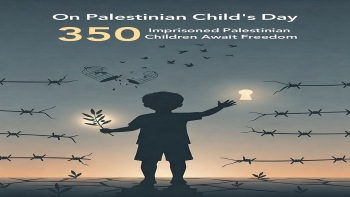
Palestinian children in Israeli prisons suffer from harsh and inhumane conditions of detention, which lack minimum international standards for children's and prisoners' rights. They also suffer from medical neglect, lack of health care, lack of clothing and poor food. They are deprived of family visits, and they are held in prisons with mature and criminal Israelis. In addition, they are also subjected to verbal abuse, beatings, isolation, collective punishment, and high fines.
The occupation authorities continue targeting Palestinian children by arrest and summon, where more than 90 cases have been documented during July, raising the number of minor detainees to 230. They are distributed among Ofer, Megiddo and Damoun prisons, and many of them are held in detention centers. High fines are imposed on them which reached to tens of thousands of shekels.
In a dangerous precedent that exceeded all humanitarian and legal standards, the Israeli authorities summoned the father of the child Mohammed Rabi 'Olayan (4 years) from Issawiya to interrogate him, and the father of the child Qais Firas Obeid (6 years) from the same town, to investigate the charges of throwing stones at Israeli Police vehicles.
The battle of administrative detention is continuous… 22 detainees entered an open hunger strike in July
22 detainees entered an open hunger strike in July in a protest against the policy of administrative detention for 500 detainees.
The majority of those who entered a hunger strike are ex-detainees who served many years under the administrative detention. 6 of them still on the strike which began in July, including the detainee Huthayfa Halabya who entered the strike since 37 days, Ahmad Ghannam since 24 days, Sultan Khlouf since 14 days, Wajdi Awawdeh since 9 days and Tareq Qaadan since 7 days.
The detainee Huthayfa Halabya,, confronting the strike since 37 days
Huthayfa is from Abu Dees town. He's in the 37th day of strike at Nitzan- Al Ramla prison. His health has been deteriorated since he refuses to have medical examinations and supplements and depends only on water. It is worth mentioning that he is arrested since 10/6/2018. He has cancer and he suffered from severe burns in his body when he was a child.
Many detainees have ended their strike in July after having an agreement with the prosecution to determine the period of their detention. A case in point is the detainee Jafar Ezz-Aldeen who entered a strike for 39 days against administrative detention, and the detainee Ahmad Zahran who ended his strike after 34 days.
However, the administration of prisons performed a series of systematic measures against detainees on hunger strike represented in isolating detainees in cells unfit for human life, deprivation of family visits, obstructing lawyers' visits and the frequent transfer from one prison to another.
Other than that, jailors try to provoke them by providing food for detainees on hunger strike, and they deliberately eat it in front of them.
In support of the detainees on hunger strike, detainees from the Popular Front for the Liberation of Palestine went on strike, where 20 detainees from Negev prison entered a hunger strike for a week
Detainees institutions: occupation forces arrested (421) Palestinians in May\ 2019
on . Posted in slider
Ramallah: occupation forces arrested (421) Palestinians from the Palestinian territories in May\ 2019 including (78) minors and (6) females.
Detainees' institutions and Human Rights Organizations (the Commission of Detainees and Ex-detainees' Affairs, the Palestinian Society Prisoner's Club, Al Dameer Association for Human Rights) pointed out in a fact sheet that the occupation authorities have arrested (145) citizens from Jerusalem, (59) from Ramallah, (60) from Hebron, (30) from Jenin, (21) from Bethlehem, (32) from Nablus, (13) from Tulkarem, (19) from Qalqilya, (8) from Tubas, (8) from Salfit, (14) from Jericho and (12) from Gaza Strip.
Number of detainees in Israeli jails became (5500) at the end of May, including (43) females, (220) minors and (500) administrative detainees.
The following is the most prominent policies and measures practiced by the occupation authorities in May:
Hunger strike in May/ 2019
Many detainees continued their hunger strike during May, in a protest against their administrative detention, such as: Hasan Ewaiwi who started his strike in April and his health condition deteriorated. However, the occupation authorities refused to end his administrative detention.
The commission documented many punitive measures implemented by the administration of prisons against him, such as isolating him, depriving him of family visits, continuous transfer from one prison to another and transferring him to civil hospitals. The detainee Ewaiwi from Hebron, 35, is married and a father of three kids. He was arrested many times before, the last of which was in January 15, 2019.
Moreover, the detainee Bassam Abu Aker from Aydah camp/ Bethlehem entered a hunger strike in May, 21 protesting against his two years of administrative detention. He ended his strike after having an agreement to determine the period of his administrative detention.
Abu Aker is one of the leaders who spent (24) years in prison, knowing that he is detained since July, 2017 under the administrative detention, and he is a father of 7 kids.
Detainees who entered hunger strike in May are Ahmad Hroub from Hebron, Thaer Bader from Bait Liqya, Mu'taz Ubaido from Hebron and Murad Malaysheh from Jenin.
Medical negligence
There are (750) detainees who still suffer from medical negligence by the administration of occupation prisons, where it is a policy that is practiced against them in a systematic way as a means of revenge.
The occupation authorities use the policy of medical negligence as a means of torture and pressure against detainees, aiming at obtaining confessions or breaking their will and increasing their suffering. For example, the clinics of prisons lack medical staff and devices to make necessary examinations. All health problems are dealt with using painkillers.
In case of health deterioration of the detainee he will be transferred to the clinic of Ramlah prison, where there many incurable cases of detainees suffering severe deterioration in their health status. Currently, there are 15 detainees held at the Ramlah prison clinic in inhuman conditions.
Detainees' institutions continuously document many cases of racist treatment against detainees in Israeli hospitals, in addition to handcuffing the detainee during his stay in hospital.
The occupation authorities deliberately procrastinate in providing the appropriate therapy for sick detainees and in the necessary tests to diagnose the condition of the patient, which leads to the aggravation of the disease.
The summer and detainees' suffer in Israeli jails
The Israeli authorities seek to make the detainees live in pain and suffering even in climatic fluctuations. With the high temperature and humidity in Israeli prisons and detention centers, the detainees' suffering increase especially in the desert and near- coast prisons that are full of insects and bad smell. Detainees are deprived of obtaining fans and air conditioners, where the administration of prison deliberately cut off cold water in the isolation cells.
According to testimonies, complaints by detainees increase regarding the high temperature in desert- prisons such as "Beersheba", "Nafaha", "Remon" and "Negev", old prisons such as "Damoun", isolation prisons such as "Nitzan" and prisons of high humidity such as "Shatta" and "Jelboua".
60.000 NIS of fines against minor detainees at Ofer prison in May
The Israeli courts imposed in May sentences of actual imprisonment against a number of minors detained at Ofer prison, in addition to high fines up to 60.000 NIS.
43 minors got detained in Ofer prison in May, including (22) who were arrested from their houses, (12) from roads, (7) for not having a permit and (2) after summon.
Moreover, (4) of them have been shot by the occupation forces, and (9) were exposed to intensive beating and humiliation during arrest. The sentences ranged between 31 -10 months of imprisonment.
36 Palestinian female detainees are held in the Israeli jails in endless suffering
on . Posted in slider
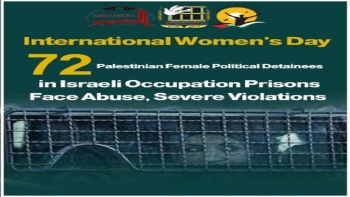
The Commission of Detainees Affairs reviewed in a report the cruel circumstances in which Palestinian women detainees live over the years of long conflict with the Israeli occupier, where more than 17.000 Palestinian females have experienced detention in Israeli jails since 1967.
The Commission pointed out that period of the first Intifada which began in 1987, witnessed the largest campaigns of detention against Palestinian women. On one hand, the number of detention cases among women reached up to 3000. On the other hand, 1000 Palestinian women have been arrested during the second Intifada which began in 2000.
Since 2009- 2012, detention against women decreased but it increased again with the outbreak of the popular Palestinian uprising in 2015. It continued to 2018, which witnessed a high increase in detention cases against Palestinian women, especially the strugglers in Al-Aqsa Mosque. However, 35 Palestinian women are currently held in the Israeli jails.
The Commission stated that all women detainees are held at Damoun prison in inhumane and cruel conditions, including 20 mothers and 6 wounded women. The highest sentence reached to 16 years of imprisonment, and half of them are under arrest.
All women detainees suffer from the policy of medical negligence, especially those who are wounded. They complain about the absence of gynecologist and the lack of appropriate medicines.
The detainee Israa Jaabees is the most difficult cases. She needs an urgent surgery after having severe burns during arrest, where 8 of her fingers were amputated but the occupation authorities still procrastinate in conducting the operation.
The commission also stated that women detainees suffer from the transportation during the transfer to Hasharon prison, deprivation of family visits, lack of a kitchen in the prison and the surveillance cameras installed permanently in the prison's yard.
The Commission of Detainees and Ex-Detainees' Affairs reviews the deterioration of health conditions for many detainees at Negev prison
on . Posted in slider
The Commission of Detainees and Ex-Detainees' Affairs reviewed in a report the bad health conditions of many detainees in Negev prison, which get worsened day by day due to the policy of medical negligence practiced by the administration of Israeli prisons.
The commission pointed out that the detainees Muhammad Farouq Abu-alrub, 45, from Jenin is suffering from otitis media causing dizziness and severe pain in head. He also suffers from troubles in heart valves without receiving any treatment, noting that he's detained since 2002 and sentenced to 30 years.
The detainee Imad Abu Zaineh, 30, from Jericho suffers from an injury in his right hand and severe pain in the testes, in addition to skin irritation under the eye.
The detainee Saher Abu Omar, 35, from Nablus suffers from fractures in his right hand due to an attack during the interrogation, and he was incorrectly treated.
The detainee Abdullah Kharouf, 30, from Nablus suffers from a slipping between the fourth and fifth vertebrae, and has not received any medical treatment and only given painkillers.
Another case in point is the detainee Basem Naasan who is detained in Ashkelon prison. The commission stated that the administration of Ashkelon prison is procrastinating in providing the appropriate treatment for the detainee Basem Naasan, 24, from Al-mughayer\ Ramallah, whose health condition is very bad. He was injured in his left leg before his detention which caused troubles in the colon. He is in urgent need of an operation as soon as possible, but the administration of "Ashkelon" keeps procrastinating.
The disabled detainee Saleh Saleh, 23, from Balata camp\ Nablus is permanently detained at Al-Ramla clinic. His health deteriorated recently due to problems in the nerves, and he's in urgent need to be examined by a specialized doctor to have a surgery and receive the appropriate medical treatment.
However, the detainee Fawaz Baara, 48, from Nablus is held in Jelboa prison. He's suffering from very bad health conditions. He has cancer since 2007. He had many surgeries but his health condition worsened and got infected. Then, he got moved Al-Afoula Hospital to undergo a catheterization.
The administration of Ofer prison is deliberately neglecting the health condition of the detainee Mahmoud Abu Wardeh, 41, from Al-Fawar camp\ Hebron. He suffers from a slipping in the vertebrae, gastric ulcer and heart diseases. He did not receive any medical examinations or treatment until now.
Another case in point is the detainee Ahmad Amawi, 27, from Gaza. He has severe pain in his right hand due to an injury during his arrest. He also suffers from infections in the stomach and problems in the urine. He had medical examinations in the clinic of Nafaha prison but has not been informed of the results.
The Commission stated that the administration of Israeli prisons is deliberately neglecting the health conditions of sick detainees, where 700 sick detainees in the Israeli jails have complicated cases such as cancer and kidney and heart diseases.
The detainee Ewaiwi continues his hunger strike for 69 days with difficult medical conditions
on . Posted in slider
The Commission of Detainees and Ex-Detainees' Affairs stated today that the detainee Hasan Ewiawi continues his open hunger strike since 69 days against his administrative detention, amid warnings of the deterioration of his health condition.
The Commission said that the administration of Israeli prisons transferred the detainee Ewaiwi last Thursday from "Nitzan al-Ramla" detention center to Barzilai Hospital after a serious deterioration in his health.
The Commission also said that the detainee Ewaiwi is suffering from weight loss, severe pain in the joints, waist and head, a constant feeling of cold, stomach aches, inability to stand up and move, in addition to ill-treatment by jailers.
The Israeli occupation authorities hold full responsibility on the health and life of the detainee Ewaiwi , where he is prevented from family visits and lawyer visits, the Commission stated.
It is worthy to mention that Ewaiwi is a father for three kids. He was detained before in January and sentenced to 4 months under administrative detention.
His administrative detention was renewed for the second time, which led him to enter an open hunger strike protesting against the renewing of the administrative detention without any charge.