

- Details
- Category: News
- Hits: 431
? Palestinian Detainee in West Bank Martyred in Occupation’s Custody
Commission of Detainees’ Affairs and the Palestinian Prisoner's Society
October 19, 2025
Ramallah, occupied Palestine – Israeli occupation authorities have disclosed to Palestinian officials the martyrdom of Palestinian political detainee, 49-year-old Mahmoud Talal Abdullah, from the Jenin Refugee Camp on Sunday while he was held at the occupation’s Assaf Harofeh Hospital.
Abdullah was arrested by occupation forces on February 1, 2025. After his arrest, his health condition deteriorated significantly, and it was later revealed that he had advanced-stage cancer. He was transferred from Megiddo Prison, then Gilboa Prison, and later to the Ramleh Prison Clinic. Despite medical tests confirming his cancer diagnosis at an advanced stage, the occupation refused to release him and kept him in custody until he died. He died just one day after being transferred to Assaf Harofeh Hospital.
Abdullah was a former prisoner who was detained during the Second Intifada in 2002, spending two years behind bars. Before his latest arrest, he suffered from health problems and was undergoing treatment. His re-arrest deprived him of completing his medical care.
The Commission of Detainees’ Affairs and the Palestinian Prisoner's Society hold the occupation authorities fully responsible for the martyrdom of detainee Mahmoud Abdullah. His martyrdom adds to a series of complex crimes committed by the occupation system, as part of a systematic policy of killing prisoners, within the framework of an ongoing genocide against the Palestinian people. This crime is a direct continuation of the testimonies of hundreds of released prisoners, which document systematic torture and violations, considered crimes against humanity and war crimes, confirming that what takes place inside the prisons is part of a part of the genocide.
With the killing of detainee Mahmoud Abdullah, the number of identified martyred Palestinian prisoners since the beginning of the genocide has risen to 79 people, amid ongoing crimes of forced disappearance affecting dozens of detainees. This current phase marks the deadliest period in the history of the prisoners’ movement since 1967. According to documented data from prisoners’ organizations, the number of known prisoner martyrs has reached 316 people, and the number of withheld bodies (before and after the war) has risen to 87 people, including 76 people since the war began.
The two institutions emphasized that the accelerating pace of prisoner killings in this unprecedented manner confirms once again that the Israeli prison system continues to implement a policy of slow killing. Not a month goes by without the announcement of a new martyr among the detainees. With daily crimes ongoing inside prisons, the number of martyrs is expected to rise, especially as thousands of detainees are held in conditions lacking the most basic necessities of life, and are exposed to systematic violations, including: torture, starvation, physical and sexual assault, medical neglect, spread of infectious diseases, particularly scabies as well as unprecedented levels of deprivation and punitive measures.
In addition to all this, there have also been field executions of dozens of detainees. The images of bodies recently returned after the ceasefire serve as clear evidence of the level of brutality inflicted on numerous prisoners in the field.
The PPS and the Commission call on the international human rights system to take effective measures to hold the leaders of the occupation accountable. They called for the imposition of clear international sanctions that would isolate the occupation, restore the true role of the human rights system, and put an end to its paralyzing state of inaction during the genocide. They also demanded an end to the exceptional impunity granted to the occupation by certain global powers—treating it as if it were above the law and accountability.

- Details
- Category: News
- Hits: 361
Two detainees in “Negev Prison” subjected to deliberate medical negligence
October 19, 2025
The Commission of Detainees and Ex-Detainees Affairs reported on Sunday, following a visit by its lawyer, that two detainees being held in the Negev Prison are suffering from severe health conditions.
The first case concerns detainee Jihad Youssef (19 years old) from Qalqilya, who is being held under administrative detention. He has been diagnosed with scabies, a skin disease that requires urgent treatment, and is also suffering from swelling in the groin area. Youssef told the Commission’s lawyer that detention conditions remain difficult, noting that detainees continue to face frequent searches and daily raids. He added that authorities are enforcing collective punishment measures without justifications, such as denying detainees their recreation time, limiting access to cleaning materials, and failing to provide adequate clothing.
The second case involves detainee Mohammad Raja (27 years old) from Ramallah, who is also under administrative detention. He suffers from severe pain in his left ear after being assaulted by prison guards, which caused inflammation and painful infections.
The lawyer also visited the following detainees, who were found to be in good health:
. Youssef Zahran (33 years old) from Ramallah, currently serving his fourth term under administrative detention.
. Mostafa Karameh (23 years old) from Kafr Aqab / Jerusalem, who suffers from different health problems pain and is held under administrative detention.
. Walaa Amr (30 years old) from Hebron, detained since December 22, 2023, under administrative detention, and recently received a substantive ruling in his case.
- Details
- Category: News
- Hits: 374
Prisons as a Frontline of Genocide: Two Years of War Crimes Against Palestinian Political Detainees
Palestinian Prisoner’s Society, Commission of Detainees’ Affairs, and the Addameer Prisoner Support and Human Rights Association
October 7, 2025
Ramallah, occupied West Bank - Two years into the Israeli occupation’s genocide in Gaza and its widespread assault across historic Palestine, the Palestinian Prisoner’s Society, the Commission of Detainees’ Affairs, and the Addameer Prisoner Support and Human Rights Association present a report on the condition of Palestinian political prisoners. This includes critical data and an overview of the ongoing violence inside Israeli occupation prisons—an extension of the broader campaign of erasure and genocide of Palestinians.
Since the start of the genocide, detainees have been subjected to deliberate killings inside prison walls. Some have been beaten to death, while others have died due to systemic denial of medical care, starvation, and other inhumane practices. These abuses, though not new, have intensified dramatically, resulting in the highest recorded number of killings of Palestinian prisoners in recent history.
At least 77 Palestinian political prisoners have been confirmed killed since the genocide began, while dozens of detainees abducted from Gaza remain forcibly disappeared, with their bodies withheld by the occupation. These crimes reflect a broader pattern of settler-colonial violence and systematic attempts to destroy Palestinian prisoners.
Full report in English below
Prisons as a Frontline of Genocide: Two Years of War Crimes Against Palestinian Political Detainees
Fact Sheet by the Palestinian Prisoner’s Society, Commission of Detainees’ Affairs, and the Addameer Prisoner Support and Human Rights Association.
October 7, 2025
Ramallah, occupied Palestine - Two years since the start of the Israeli occupation’s escalating genocide against our people in the Gaza Strip, and the comprehensive aggression across historic Palestine, the Palestinian Prisoner’s Society (PPS) and other prisoner institutions present a fact sheet on the issue and reality of political prisoners. This includes key data and figures as well as an overview of the horrific conditions in the Israeli occupation’s prisons which constitute one aspect of the genocide, whereby Palestinian political detainees are being subject to unprecedented settler-colonial violence and erasure.
Over the past two years, detainees have been exposed to deliberate murder behind bars at the hands of the Israeli occupation’s prison services. This includes direct killing such as beating detainees to death, and other indirect killings through inhumane policies including denial of the right to medical care and starvation. These actions, which existed before but intensified greatly since the genocide in Gaza, have led to a record number of Palestinian political prisoners killed. There have been 77 identified murdered Palestinian political prisoners since the genocide began, while dozens of other detainees abducted from Gaza were martyred and their bodies remain withheld by occupation authorities and subject to enforced disappearances.
This figure stands as irrefutable evidence of one of the most brutal periods in the history of the Palestinian prisoner movement, which has long resisted a prison system designed to physically and psychologically destroy detainees.
Relying on hundreds of documented testimonies, material evidence, and public threats by Minister Itamar Ben Gvir and the far-right Israeli government, the PPS and other institutions affirm that the crimes against prisoners constitute large-scale war crimes and crimes against humanity. The Israeli judicial system, including its Supreme Court, has provided legal cover for this brutality.
These crimes include torture, killing, looting, starvation, the intentional spread of disease, denial of medical care, sexual assaults including rape, and collective isolation — all aimed at the systematic killing of Palestinian prisoners. The scale of violence over the past two years has exceeded all legal definitions, violating international laws and conventions, amid unprecedented global inaction — especially due to the protection granted to these crimes by international powers, chiefly the United States.
Nevertheless, as human rights institutions, and despite the bleakness of the reality, we cannot ignore the role of principled human rights advocates, nor the importance of activating international decisions that support our people’s right to freedom and self-determination.
While the occupying state continues to commit its ongoing crime of genocide over the past two years, we are now witnessing the continued detention of dozens of activists from the Sumud Flotilla who, in their testimonies, revealed that they were subjected to abuse, ill-treatment, and detention under harsh conditions. This has been accompanied by public threats made by the Ben Gvir against the activists, whom he described as “terrorists.” In this context, the institutions express their salute to all the activists who attempted to break the siege imposed on our people in Gaza.
Key Policies and Violations Documented by Prisoner Rights Institutions
We have documented an unprecedented escalation in the scale and scope of systematic crimes and violations widely practiced against Palestinian political prisoners since the beginning of the genocide. Among the most prominent of these crimes are:
- Torture in all its physical and psychological forms.
- Systematic starvation and denial of sufficient and balanced food.
- Medical crimes, including denial of treatment and deliberate imposition of conditions that lead to the spread of diseases and epidemics.
- Collective isolation and policies of deprivation affecting all aspects of prison life.
- Systematic repression and attacks carried out by special units of the Israeli Prison Services, notably the Keter, Metzada, and Nahshon units.
- Violent physical assault, including the use of gas, stun grenades, and electroshock weapons.
- Policies of humiliation, including strip searches and sexual assault, including rape.
- Using illness as a tool of torture, as seen in the outbreak of scabies skin disease.
- Psychological terror, solitary confinement, and threats of murder.
- Enforced disappearance has also become a policy, particularly targeting detainees from Gaza.
Additionally, there has been a massive surge in the use of the policies of “administrative detention” and “unlawful combatants” both of which allow detention without trial or charge for indefinite periods without due process.
Martyred Prisoners: The Most Violent Era in the History of the Prisoner Movement
The number of martyred Palestinian political prisoners whose identities have been confirmed has reached 77 people, all of whom were killed through either torture, starvation, or denial of medical treatment, or a combination of them all. These are only those whose identities have been revealed; the bodies of dozens of detainees from Gaza who have been killed remain forcibly disappeared.
In addition, occupation authorities continue to withhold the bodies of 85 martyred prisoners who were killed in detention, 74 of whom were martyred since the start of the genocide.
The total number of martyrs of the Palestinian prisoner movement since the occupation of 1967 is estimated at 314 people, according to documentation compiled over the decades.
We emphasize here that the occupation’s claims of opening “investigations” into the circumstances of some prisoner deaths and killings — following formal requests from certain human rights institutions — are nothing more than a policy of deception and deliberate stalling.
The Case of Palestinians Detained from Gaza
The testimonies and accounts of detainees from Gaza have marked a pivotal shift in understanding the level of brutality practiced by the occupation system. These testimonies have revealed an unprecedented pattern of systematic torture, beginning from the moment of arrest, through the stages of interrogation, and continuing into prolonged periods of detention.
The methods of repression and abuse have varied, ranging from physical and psychological torture, to beatings, starvation, and deliberate medical crimes — in addition to sexual assault. Taken together, these acts constitute a fully developed policy of extermination and genocide inside prisons and military camps.
These crimes have led to the killing of dozens of detainees, alongside field executions carried out by occupation forces during arrest. According to official data, human rights organizations have so far identified 46 martyred Palestinians among those abducted from Gaza, out of a total of 77 prisoners killed since the start of the genocide. Meanwhile, the occupation continues to conceal the fate of dozens of other martyred Gaza detainees.
It is also worth noting that the occupation authorities have established several camps and special sections inside prisons specifically for Gaza’s detainees. Most notable among them is the Sde Teiman camp, which has become a central site of torture and killings, and the Rakevet section, located underground in Ramla Prison, which stands as a stark example of enforced disappearance and systematic torture.
The vast majority of Gaza’s detainees officially acknowledged by the prison administration have been classified as “unlawful combatants” — one of the most prominent legal frameworks that has institutionalized torture and other grave violations against Gaza detainees, and allows their detention without trial or charge indefinitely.
Around 20,000 Arrest Cases in the West Bank, Including Jerusalem, Since the Start of the War of Extermination
(Note: This figure does not include arrests in Gaza, estimated in the thousands, nor those in the 1948-occupied territories.)
Since the genocide, the number of cases of arrest in the occupied West Bank, including Jerusalem, has reached approximately 20,000, including around 1,600 arrests among children and about 595 among women. This figure includes those who were arrested and remain in detention, as well as those who were later released. It marks a historic and unprecedented number of arrests over just two years. It is important to note that this number does not include cases of arrest among Gaza’s residents, estimated in the thousands, nor arrests that occurred in the 1948-occupied territories.
These mass arrests in the West Bank have been accompanied by unprecedented crimes and violations, including brutal beatings, acts of terror against detainees and their families, widespread vandalism and destruction of homes, confiscation of vehicles, money, and gold, and the extensive destruction of infrastructure — particularly in Tulkarem, Jenin and their refugee camps. Violations also included the demolition of prisoners’ family homes, use of family members as hostages, use of detainees as human shields, and field executions. Moreover, arrests have been used as a cover for illegal settlement expansion in the West Bank.
The total number of arrests since the beginning of the genocide includes: Those detained from their homes, at military checkpoints, those who surrendered under pressure, those taken as hostages, and individuals held for long hours under field interrogation.
Widespread field interrogations have targeted thousands since the beginning of the genocide, during which occupation soldiers have committed crimes comparable to those in formal detention centers.
Categories of Arrests
- Journalists: A total of 202 journalists have been arrested since the start of the genocide. The majority were either placed under “administrative detention” – detention without trial or charge - or faced charges related to what the occupation calls “incitement” — essentially detaining individuals for freedom of expression. Two journalists from Gaza, Nidal Al-Wahidi and Haitham Abdel Wahid, remain under enforced disappearance.
- Doctors and Medical Staff: According to the Ministry of Health, about 360 medical professionals have been arrested, including three who died in detention due to torture:
Iyad Al-Rantisi, Adnan Al-Barsh, and Ziad Al-Dalu.
? Data and Statistics on the Number of Prisoners – October 2025
The number of prisoners in Israeli occupation prisons has more than doubled, with the majority of detainees held under administrative detention, meaning without charge. The issue of administrative detention has become one of the most significant developments in the prisoner file.
This data is based on reports from prisoner advocacy institutions and figures released by the Israeli Prison Service up to October 2025.
- Total number of Palestinian political prisoners: Over 11,100 people held in the Israeli occupation’s prisons, majority held under administrative detention without trial or charge, or are awaiting trial. (This number does not include detainees held in military camps run by the Israeli army.) It is the highest recorded total since the start of the Second Intifada in 2000, according to documentation by relevant institutions.
- Sentenced prisoners: Over 1,460 individuals currently serving sentences.
- Prisoners sentenced to life imprisonment or facing life sentence charges: Around 350, including 303 already sentenced, and 40 facing indictments for life sentences.
- Abdullah Al-Barghouti holds the highest sentence: 67 life terms.
- Followed by Ibrahim Hamed: 54 life terms.
- Prisoners detained since before the Oslo Accords: 17 prisoners, including four who have been held since 1986: Ibrahim Abu Mokh, Ibrahim Bayadseh, Ahmed Abu Jaber, and Samir Abu Nima.
- Prisoners sentenced between 10 and 20 years: 131 people
- Prisoners sentenced between 21 and 30 years: 166 people
- Female prisoners: 53 women are currently held behind bars, including three from Gaza, and two minor girls.
- Child prisoners: Over 400 children are currently detained, mostly in Ofer and Megiddo prisons.
- Pre-trial detainees: Around 3,380 individuals are awaiting trial (as of October 2025).
- “Administrative detainees”: 3,544 detainees, making it the largest category of prisoners compared to sentenced or pre-trial detainees, or “unlawful combatants”.
- “Unlawful combatants”: 2,673 detainees classified under this designation, though the number does not include all Gaza detainees held in military camps. This classification also applies to Arab detainees from Lebanon and Syria.
Prisoners’ Numbers Before the Genocide
? The total number of prisoners before the genocide exceeded 5,250 people, including around 40 female prisoners and 180 children. The number of “administrative detainees” stood at approximately 1,320 people.
Since the beginning of the genocide, occupation authorities have denied prisoners' families the right to visit, and have also banned the International Committee of the Red Cross from visiting prisoners in detention.
It is also important to note that Palestinian human rights institutions are facing severe challenges and a systematic campaign of elimination, which has escalated to an unprecedented level — particularly after the United States designated the Addameer Prisoner Support and Human Rights Association as a “terrorist” organization, and imposed sanctions on three other organizations: Al-Haq, the Palestinian Centre for Human Rights (PCHR), and Al-Mezan Center for Human Rights.
All the data used by these institutions is based on: Legal teams who visit and follow up on prisoners, testimonies of released prisoners, and daily monitoring and documentation.
The institutions renew their call on the international system to shed its cloak of inaction and complicity in the face of this extermination war. These crimes have reached a level that words can no longer describe. What is happening is part of a broader campaign of ethnic cleansing and erasure, and the violations committed against prisoners and detainees are a direct extension of the war of extermination and genocide. The ongoing international silence in the face of these crimes is a violation of humanity as a whole, and the consequences of this genocide will extend to all who have used inaction as a pretext to evade their responsibilities.
To access the reports, fact sheets, and statements issued by the three institutions over the past two years of the war, please refer to the following official websites:
- Commission of Detainees’ Affairs:
https://cda.gov.ps/index.php/ar/ - Palestinian Prisoner’s Society:
https://www.ppsmo.ps/ - Addameer Prisoner Support and Human Rights Association:
https://addameer.ps/ar
******ENDS******

- Details
- Category: News
- Hits: 259
Martyrdom of 22-year-old Palestinian Political Prisoner Held Without Trial or Charge
Commission of Detainees’ Affairs & Palestinian Prisoners Society
October 7, 2025
Ramallah, occupied Palestine - Israeli occupation authorities have revealed to the General Authority for Civil Affairs the martyrdom of 22-year-old Palestinian detainee Ahmad Hatem Mohammad Khdeirat. From the town of al-Thahiriyeh in Hebron in the southern occupied West Bank, Khdeirat was arrested on May 23, 2024. He was held without trial or charge despite his chronic diabetes and was placed in inhumane conditions in the notorious Naqab Prison for most of his detention.
In recent months, Khdeirat’s health severely deteriorated after contracting scabies skin disease, which caused intense itching and repeated seizures. He also suffered from severe hunger episodes, dangerously low blood sugar due to his condition, and extreme difficulty moving or meeting his daily needs. His weight dropped to about 40 kilograms. According to a lawyer who visited him in August, Khdeirat had been unable to get out of bed for two months.
The Commission of Detainees Affairs’ and the Palestinian Prisoner’s Society emphasized that Khdeirat’s martyrdom adds to the list of compound crimes committed by the occupation system, as part of its ongoing genocide against the Palestinian people and its policy of killing prisoners and detainees.
With Khdeirat’s killing, the number of martyrs from the prisoners’ movement since the beginning of the genocide has risen to 78 people, and this number includes only those whose identities have been confirmed, amid the ongoing crime of enforced disappearance affecting dozens of detainees. This phase marks the bloodiest period in the history of the prisoners’ movement since 1967, with the number of confirmed martyred prisoners reaching 315 people, according to documented data from prisoners’ institutions.
The two institutions confirmed that the continued and unprecedented rise in the number of prisoner killings proves once again that the occupation’s prison system is persistently implementing a policy of slow killing. Not a month goes by without a new martyr being recorded among the prisoners. With the continuation of daily crimes inside prisons, the number of martyrs is expected to rise, as thousands remain detained in conditions lacking the most basic requirements of life, constantly subjected to systematic crimes including: torture, starvation, physical and sexual assault, medical crimes, and the spread of infectious diseases, primarily scabies, in addition to unprecedented policies of deprivation and abuse.
The Commission and the PPS hold the occupation authorities fully responsible for Khdeirat’s martyrdom and renewed their call to the international human rights system to take serious decisions and actions to hold the leaders of the occupation accountable for war crimes committed against prisoners and the Palestinian people. They also called for the imposition of clear international sanctions to isolate the occupation, restore the role of the human rights system for which it was established, end the horrifying paralysis that has gripped it during the genocide, and put an end to the exceptional impunity still granted to the occupation by international powers — as if it were a state above the law, beyond accountability and justice.

- Details
- Category: News
- Hits: 257
The number of elderly Palestinian detainees(aged 60 and above) in Israeli occupation prisons has reached 117, including 13 serving life sentences.
#International_Day_for_Older_ Persons

- Details
- Category: News
- Hits: 305
Three detainees endure critical health conditions in Gilboa Prison
September 21, 2025
The Commission of Detainees and Ex-Detainees Affairs reported on Sunday, following a lawyer’s visit, several alarming medical cases among detainees held in Gilboa Prison. One of them is Bilal Othman (48) from Beit Rima/Ramallah, who suffers from chronic kidney disease. He has only one kidney due to an injury sustained in 1994. In addition, he struggles with blood clotting and gout. Recently, he had scabies, which has caused him severe itching and the appearance of boils, yet the prison administration continues to deny him proper medical treatment.
Othman was also burned by guards who poured boiling water on his left hand. He further suffers from a fractured finger on the same hand after the prison’s suppression unit raided his cell, beating all those inside. He was struck with iron batons on his back, legs, and arms, which caused the fracture. Despite his condition, he has not received any medical care.
It should be noted that Othman has been imprisoned since 2002 and is serving 15 life sentences in addition to 35 years.
Another case is detainee Mohammad Daraghmeh (34) from Tubas, who also suffers from scabies and severe itching, along with slipped discs in his back and neck. He has lost nearly 15 kilograms of weight.
As for Mohammad Sarhan (25) from Al-Far’a refugee camp, who is held under administrative detention, he too suffers from scabies, accompanied by severe itching and the spread of boils across different areas of his body.
- Details
- Category: News
- Hits: 401
Monthly Briefing on Palestinian Political Prisoners - August 2025
*The Commission of Detainees Affairs’, The Palestinian Prisoner’s Society, Addameer Prisoner Support and Human Rights Association.*
September 14, 2025
Ramallah, occupied Palestine - Israeli occupation authorities carried out 540 arrests of Palestinians in the occupied West Bank and Jerusalem, during August 2025. Among them were 49 children and 19 women. The total number of recorded arrests in the occupied West Bank since the start of the genocide in occupied Gaza has risen to over 19,000, including more than 590 arrests among women and 1,550 arrests among children. These figures do not reflect the current number of Palestinian political prisoners – they include both those who remain in detention and those who were later released. They also do not include the total arrests among Palestinians in occupied Gaza, which are estimated to be in the thousands.
The Commission of Detainees Affairs’, the Palestinian Prisoner’s Society, and the Addameer Prisoner Support and Human Rights Association publish this monthly briefing based on lawyers’ visits to detainees among other documentation. Israeli occupation forces have consistently and relentlessly carried out mass arrests across the occupied West Bank, Jerusalem and Gaza since the genocide. This includes abducting residents of Gaza as they waited for humanitarian aid—aid that the occupation has turned into a trap for murder, arrests, and abuse.
Israeli occupation forces carry our night-time raids and the violent storming of homes, accompanied by the deliberate destruction of family internal and external property in a manner that resembles settler attacks. Detainees and their families are often subjected to physical assaults, threats of killing, and various forms of humiliation. In many cases, families are held hostage while soldiers loot money, jewelry, and electronic devices. Field interrogations are frequently conducted either inside homes or in makeshift military barracks. Most gravely, there has been a sharp and unprecedented rise in field executions since the start of the genocide.
The sharp rise in organized settler attacks in the occupied West Bank has led to an increase in mass arrests of residents, especially in villages and areas targeted by illegal settlement expansion, where dozens of civilians were arrested and interrogated in the context of escalating confrontations with illegal settlers.
The use of “administrative detention” – or detaining residents without trial or charge indefinitely – has continued to escalate, serving as a tool used by the occupation to suppress any form of active political, social, or cultural engagement. This policy targets a wide range of individuals, including students, journalists, human rights defenders, and former prisoners, aiming to dismantle the foundations of civil society. Today, administrative detainees make up over 32 percent of the total prisoner population, including women and children. Since the beginning of the genocide, approximately 90 percent of appeals and petitions filed against administrative detention orders have been rejected by the occupation’s courts, revealing their entrenched role as a central mechanism in legitimizing this policy through sham trials wholly controlled by the intelligence services.
The Reality for Prisoners
The Israeli prisons administration is committing widespread violations and crimes against Palestinian detainees. Testimonies gathered by legal teams during their visits reveal a worsening health catastrophe inside the prisons, with diseases spreading rapidly and severe weight loss reported as a result of deliberate starvation. Scabies skin disease is being used for further abuse, recently spreading widely in Ofer Prison amid growing concerns that it may return on a larger scale to Naqab Prison. Other forms of diseases are also developing.
The occupation authorities continue their systematic repression operations against prisoners using various types of weapons, including electric shocks and rubber bullets. These assaults include women and children. Prisoners’ institutions have documented four large-scale crackdowns on female prisoners in August, during which they were subjected to degrading treatment, handcuffed, forced to kneel, strip searched, and sprayed with gas. In addition, assaults targeted sick prisoners, including a crackdown on ill detainees in the "Ramleh prison clinic," where they were sprayed with gas. It is worth noting that such crackdowns were among the causes that led to the killing of detainees after the genocide.
Martyred Detainees in August 2025
Due to the ongoing crimes in occupation prisons, 20-year-old Ahmad Saeed Tazaz’a from Jenin was killed in August 2025; his death was announced on August 3, 2025. He was held without trial or charge under “administrative detention”. It was also announced that 20-year-old Musab Abdulmonim Al-‘Aida from Hebron was martyred after being shot in the city of Hebron prior to his arrest, having sustained critical injuries.
Targeting of Imprisoned Leaders
During the month of August 2025, we witnessed a direct threat made against political leader Marwan Barghouthi by the fascist minister of national security Itamar Ben-Gvir, who stormed his cell in Rimon Prison. Prisoners’ institutions considered this act a direct threat to assassinate leader Barghouthi and the leadership of the Palestinian prisoners' movement in the occupation prisons, who are being subjected to assassination attempts through repeated assaults and continued solitary confinement since the start of the genocide. It is worth noting that Itamar Ben-Gvir has consistently and systematically incited the killing of prisoners and the execution of further systematic crimes against them. He has repeatedly appeared in footage from inside the prisons, showcasing his crimes and the assaults carried out by repression forces against the prisoners, while broadcasting more incitement against them and openly calling for their execution.
Palestinians Arrested From Gaza
The issue of Palestinian detainees arrested from Gaza continues to dominate the scene due to the level of crimes and atrocities they are being subjected to in Israeli occupation’s prisons and military camps. Prisoners’ institutions have recently documented additional testimonies from detainees abducted from Gaza held in these facilities.
One of the most notable recent visits was to the underground"Rakevet" section of Ramleh Prison, where detainees emerged weeping uncontrollably from the horrors they endure—continuous torture, abuse, starvation, and terror around the clock. The testimonies from the "Rakevet" section add to the hundreds already collected from Gaza detainees about the atrocities they have faced since the start of the genocide, including sexual assaults, some of which involved rape to death.
Bodies of Martyred Prisoners Still Held
On the occasion of the National Day for the Retrieval of Martyrs’ Bodies, marked annually on August 27, prisoners’ institutions documented the continued detention of 85 bodies of identified martyred Palestinian prisoners, including 74 held since the start of the genocide. The policy of withholding bodies remains one of the most prominent longstanding practices used by the occupation.
Enforced Disappearance
On the occasion of the International Day of the Victims of Enforced Disappearance marked on August 30 each year, prisoners’ institutions renewed their affirmation that the occupation continues to commit the crime of enforced disappearance, which has also emerged as one of the most prominent issues resulting from the genocide.
This crime has targeted detainees and martyrs from Gaza and has been used as a cover to commit further violations, including acts of torture against detainees. Contributing to the entrenchment of this crime is the use of the "Unlawful Combatant Law," which was amended after the war and directly enabled the imposition of enforced disappearance on Gaza detainees.
Total Number of Palestinian Political Prisoners as of Early September 2025
As of the beginning of September 2025, the total number of Palestinian political detainees in Israeli occupation’s prisons exceeded 11,100, the majority of whom are held without trial or charge.
This figure does not include those held in military camps operated by the Israeli army. It represents the highest number since the outbreak of the Second Intifada in 2000, according to documentation available to institutions.
Female prisoners: Currently number 53, including two from Gaza.
• Children: Over 400 to date.
• “Administrative detainees” (held without trial or charge): 3,577 people, the highest percentage compared to sentenced prisoners and those held on charges, as well as those classified as “unlawful combatants.”
• "Unlawful combatants" (held without trial or charge): 2,662 people. This figure does not include all Gaza detainees held in military camps and classified under this category. It is also noted that this classification includes Arab detainees from Lebanon and Syria.
(ENDS)

- Details
- Category: News
- Hits: 485
Update on the Number of Palestinian Political Prisoners in Israeli Occupation Prisons as of the Beginning of September 2025
The Total Number of Prisoners in Israeli Occupation Prisons Has Increased to More Than 11,000, the Most of Them Administrative Detainees Held Without Trial or Charge
* The total number of prisoners and detainees in Israeli occupation prisons as of the beginning of September 2025 exceeded 11,100. This number does not include detainees held in Israeli army camps. This is the highest number since the outbreak of the Al-Aqsa Intifada in 2000, based on documentary data available to institutions.
* Female prisoners: Their number to date stands at 49, including two from Gaza.
* Children: Their number to date stands at more than 400.
* Administrative detainees: Their number reached 3,577 detainees, which is the highest percentage compared to the number of prisoners arrested, convicted, and classified as "unlawful combatants."
* Detainees classified as "unlawful combatants": Their number reached 2,662. This number does not include all detainees from Gaza held in camps affiliated with the occupation army and classified as "unlawful combatants." It is worth noting that this classification also includes Arab detainees from Lebanon and Syria.
Palestinian Prisoner’s Society

- Details
- Category: News
- Hits: 367
Commission of Detainees Affairs highlights detention conditions of young detainee Nour Khalifa
August 31, 2025
The Commission of Detainees Affairs reported on Sunday the latest details regarding the case of 18-year-old detainee Nour Ahmad Khalifa from Kafr Ni’ma, near Ramallah. The update followed a visit by one of the Commission’s attorneys to Khalifa at Megiddo Prison.
Khalifa was taken into custody on March 4, 2025, after Israeli forces stormed his home late at night, ransacked the property, and assaulted him with batons and firearms. He was handcuffed and transferred to a nearby military site. The next morning, he was moved to Ofer Prison, then subjected to 18 days of interrogation at the Moscobiya center, before being transferred to Megiddo.
Since his arrest, Khalifa has lost more than 15 kilograms, the result of both a health setback and the inadequate quantity and poor quality of food provided to detainees.
He was initially placed under a four-month administrative detention order, which has since been extended. His detention is now scheduled to end on November 4, 2025.


- Details
- Category: News
- Hits: 276
20-year-old Palestinian Dies Days After He Was Shot & Arrested by Israeli Occupation Forces
Palestinian Prisoner's Society & the Commission of Detainees' Affairs
August 25, 2025
Ramallah, occupied West Bank – Israeli occupation authorities have announced the martyrdom of the wounded Palestinian political prisoner, 20-year-old Musab Abdelmoneim al-Ayadeh, while he was hospitalized at the Shaare Zedek Israeli hospital in occupied Jerusalem.
Al-Ayadeh was shot by occupation forces in his hometown of Hebron in the southern occupied West Bank just four days ago - on August 21. He was then taken into custody despite his severe injuries, and brought before a military court on Sunday, August 24, at "Ofer" prison, which extended his detention.
The information of his killing was passed on to the Palestinian General Authority of Civil Affairs, which in turn informed the Commission of Detainees’ Affairs and the Palestinian Prisoner’s Society (PPS) who informed his family.
lsraeli occupation forces intended to execute al-Ayadeh when they shot him days ago, as had occurred with many other Palestinians who were killed. It later became evident that he was taken into custody and was being held at Shaare Zedek Hospital.
The killing of Al-Ayadeh adds yet another entry to the ever-growing record of Israeli brutality—field executions chief among them—which have reached unprecedented levels amid a genocide now almost in its second year.
The sharp and accelerating rise in the direct and indirect killing of detainees held in the Israeli occupation’s custody underscores its ongoing savagery. The prison system, in particular, has been fully weaponized as a tool of repression and extermination, systematically deployed to extinguish Palestinian lives behind bars. Not a single month passes without another name added to the long and growing list of martyred prisoners, a grim reflection of a regime that has normalized death as a function of its carceral machinery.
As prison crimes persist, the number of martyred prisoners is set to rise, with thousands held in conditions unfit for human life. Detainees face daily torture, starvation, assault, medical neglect, sexual violence, and deliberate exposure to infectious diseases like scabies. These are part of a broader system of deprivation designed to destroy from within.
With the martyrdom of the injured detainee al-Ayadeh, the number of identified martyred political prisoners since the beginning of the genocide rises to 77 people. Many others remain subject to enforced disappearances. This marks the bloodiest chapter in the history of the Palestinian prisoners’ movement, with 314 documented prisoner martyrs since 1967. The occupation continues to withhold 85 bodies, 74 of them killed since the start of the genocide.
We urge the human rights system to hold occupation leaders accountable, impose clear sanctions, and end the ongoing inaction that has enabled these crimes. If Israel continues to operate with impunity, as if above law and justice, these crimes will only continue and escalate, and the blood of Palestinians will only continue to be spilled.

- Details
- Category: News
- Hits: 320
Enduring Hell: Gaza Detainees Face Severe Israeli Torture and Terror Behind Bars
Briefing by the Commission of Detainees Affairs’ and the Palestinian Prisoner’s Society
August 20, 2025
Ramallah, occupied Palestine – The Commission of Detainees Affairs’ and the Palestinian Prisoner’s Society release this new briefing based on testimonies obtained – under strict conditions - by lawyers during visits to detainees conducted between late July and mid-August. The visits were conducted specifically in the underground “Rakevet” section of Ramla Prison, and the “Sde Teiman” military camp, both notorious for systematic torture of Palestinians arrested from occupied Gaza.
Those abducted from the occupied Gaza Strip are enduring the worst levels of torture and abuse compared with any other detainees.
Detainee (A.B.): “They put me in stress positions including the ‘mozeh’ (banana) position, during which I was beaten. This continued for 17 days, including once for 5 consecutive days. The interrogators would grab my testicles and beat me on them, trying to pressure me into confessing. They also blindfolded me and threw me from the chair to the ground. After being transferred to Ramla Prison, I was subjected to another round of interrogation, during which the guards broke my fingers."
Full report in English below ??
Enduring Hell: Gaza Detainees Face Severe Israeli Torture and Terror Behind Bars
August 20, 2025
Briefing by the Commission of Detainees Affairs’ and the Palestinian Prisoner’s Society
Ramallah, occupied Palestine – Nearly two years into the Gaza genocide and severe crimes against Palestinian political detainees held in the Israeli occupation’s prisons continue. Those abducted from the occupied Gaza Strip are enduring the worst levels of torture and abuse compared with any other detainees.
The Commission of Detainees Affairs’ and the Palestinian Prisoner’s Society release this new briefing based on testimonies obtained – under strict conditions - by lawyers during visits to detainees conducted between late July and mid-August. The visits were conducted specifically in the underground “Rakevet” section of Ramla Prison, and the “Sde Teiman” military camp, both notorious for systematic torture of Palestinians arrested from occupied Gaza.
In the underground “Rakevet” section of Ramla Prison, detainees came to their lawyers’ visits weeping, terrorized.
All detainees had been threatened and beaten prior to seeing their lawyers. Prison guards attempted to force detainees to lie to their lawyers and tell them that everything is “excellent.” Lawyers were forbidden from sharing any information about detainees’ families - who remain in Gaza - or the ongoing genocide.
Key testimonies revealed the continued practice of beatings and finger-breaking, along with total isolation—detainees are denied sunlight and allowed out to the yard every other day for 20 minutes, handcuffed and forced to keep their heads down.
Mattresses are distributed at night and removed in the morning, forcing prisoners to sit on metal beds all day. Guards deliberately humiliate them with insults, including forcing them to curse their own mothers and families, alongside constant threats and psychological terror. Several prisoners came to their visits weeping and terrorized. One appeared to have been severely beaten—his face covered in tears, marks on his wrists from the handcuffs. He was unable to speak about what happened to him, only trying to signal to the lawyer with his eyes. His case is not isolated; all detainees showed severe psychological distress, with fear dominating the entire lawyers’ visit.
The interrogation period stands out as one of the clearest reflections of the level of torture and grave violations inflicted by interrogators against detainees abducted from occupied Gaza.
Detainee (A.Y.): "I was arrested in December 2023 and taken to the 'barracks,' where I stayed for eight days. During that time, I was subjected to four days of 'disco' interrogation. Later, I underwent further interrogation by the intelligence services and the army, then I was transferred to Asqalan Prison, where I was held in a cell for a month without knowing day from night, and subjected to very harsh military interrogations.
They would strap me to a chair and then throw me to the ground while my hands and feet were bound. I was beaten daily for 30 days straight. I currently suffer from torn chest muscles and severe pain due to prolonged shackling of my arms behind my back. After Asqalan, I was moved to Ofer Prison, where I was shown a screen with a map to locate my home and was questioned about several locations in Gaza."
Detainee (Y.D.): "I was interrogated in the field for an hour, then transferred to the 'barracks,' where I was beaten, and then placed under the 'disco' interrogation method, where I was severely beaten, suspended in stress positions, and lost consciousness several times. They poured water on me to wake me up. The beating was so violent that my handcuffs came off twice. I was struck violently on the head, and my hair was pulled out. Now I suffer from rib fractures and I can’t sleep. The torture also caused a tear in my left ear, vision impairment, and kidney pain."
Detainee (A.B.): "I was arrested on the second day of the war. I was already suffering from a jaw injury and had undergone surgery. After my arrest, I was transferred to Asqalan Prison, where I was held for a month and a half and was subjected to military interrogation. They put me in stress positions including the ‘mozeh’ (banana) position, during which I was beaten. This continued for 17 days, including once for 5 consecutive days. The interrogators would grab my testicles and beat me on them, trying to pressure me into confessing. They also blindfolded me and threw me from the chair to the ground. After being transferred to Ramla Prison, I was subjected to another round of interrogation, during which the guards broke my fingers."
Hunger and Disease Dominate Testimonies
All detainees who were visited confirmed they are suffering from extreme hunger — one described the situation as “famine.” They are given extemely small portions of food, often inedible. Detainees collect these scraps to form a single evening meal. The amount of food provided to an entire cell is barely enough for one person. Most are experiencing severe weight loss, emaciation, and extreme exhaustion, along with worsening illnesses and health conditions.
In addition to deliberate starvation, diseases and infections continue to spread — most notably scabies skin disease, which has become one of the most pressing health issues facing the prisoners. The prison system has actively continued to its spread by depriving detainees of basic hygiene and medical care, and refusing to eradicate it.
Main Facts About Palestinians Detained from Gaza
Since the start of the genocide, Israeli occupation forces have detained thousands of civilians from across the Gaza Strip — including women, children, the elderly, the wounded, as well as medical and press personnel.
In addition to the abuses mentioned in this briefing, Israeli occupation forces have carried out other severe acts such as rape, including raping detainees to death, as well as torturing and starving them to death.
The occupation also continues to commit the crime of enforced disappearance against hundreds of detainees abducted from Gaza, refusing to disclose their identities or locations of detention. To this day, the International Committee of the Red Cross is denied access to visit them.
Due to some recent legal amendments, human rights organizations have managed to uncover the fate of hundreds of detainees, gaining access to most prisons and detention camps — including “Sde Teiman”, a key site of documented torture and medical abuse, and the underground Rakevet section of Ramla Prison.
Amid these severe abuses, dozens of detainees have been killed in custody, in addition to others extrajudicially executed upon arrest. Of the 76 identified martyred political prisoners since the genocide began, 46 were people arrested from Gaza.
****ENDS****

- Details
- Category: News
- Hits: 524
Minor detainees are taken to visits with heads covered in black bags… a blatant violation of their human dignity
”Minors Held in Harsh Conditions at “Megiddo Prison”
August 13, 2025
The Commission of Detainees and Ex-Detainees Affairs reported that the Israeli Prison Service continues to enforce abusive measures against detained minors, comparable in severity to those imposed on adult prisoners since October 7.
These children are kept in bare, empty cells, placed under heightened isolation, and denied family visits, part of the broader policy that has barred thousands of detainees from seeing their families.
The Commission explained that, in Megiddo Prison, minors are deliberately brought to family visits with their hands and feet shackled, blindfolded, and their heads covered with black bags. Upon entering the visiting room, the blindfold is removed, but their hands remain restrained in a way that makes holding the phone extremely difficult, while their feet remain chained. Despite repeated appeals from legal representatives to remove the restraints during visits, prison authorities consistently refuse.
Following a recent visit to the minors, the Commission’s lawyer reported that the prison cells fail to meet even the most basic international standards for the rights of children and detainees. They are filthy, infested with insects, poorly ventilated, and inadequately lit. The detained minors are subjected on a daily basis to verbal abuse, beatings, solitary confinement, sexual harassment, and collective punishment.
- Details
- Category: News
- Hits: 312
Abu Al-Hummos warns of escalating psychological abuse against detainees in Ofer Prison
August 8, 2025
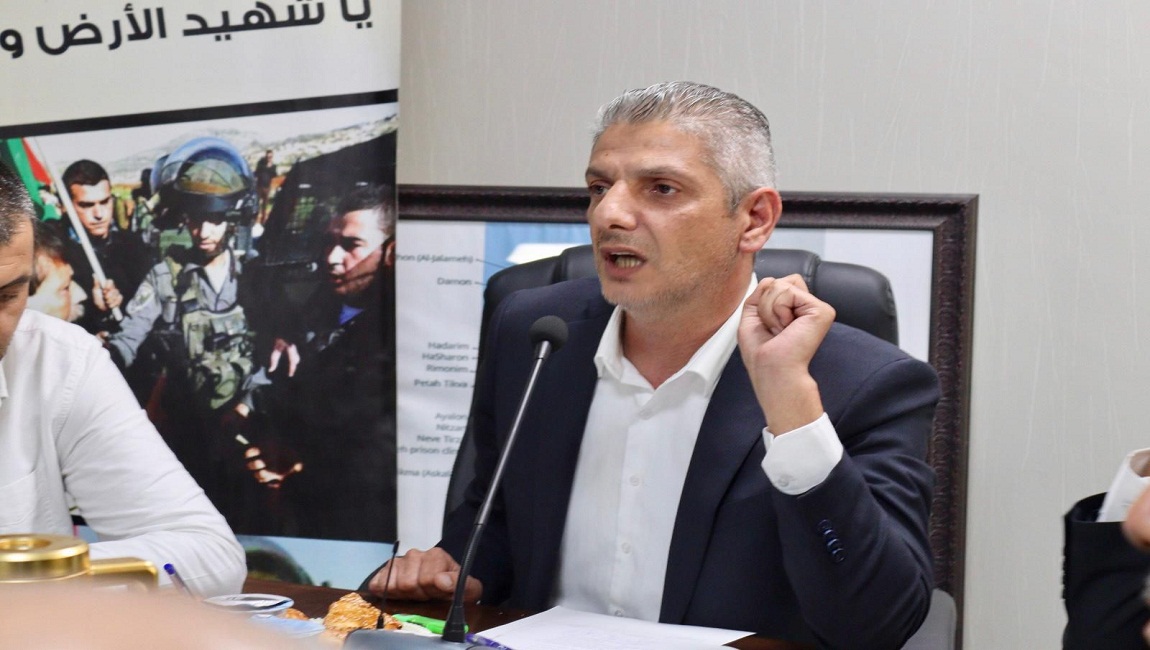
The Head of the Commission of Detainees and Ex-Detainees Affairs, Raed Abu Al-Hummos, issued a warning on Friday over the mounting psychological abuse inflicted on detainees in Ofer Prison, describing the situation as rapidly worsening and extremely alarming.
His remarks followed his review of a report from the Commission’s lawyer, who had recently visited several detainees in Ofer. The detainees’ testimonies revealed serious threats to their lives, with a clear and deliberate focus on breaking their resolve and morale through systematic psychological exhaustion, aimed at rendering them mentally unstable and emotionally broken.
Abu Al-Hummos noted that the overall conditions inside Israeli prisons and detention centers are harsh and dangerous, and that Israeli policies toward detainees have reached unprecedented levels of severity. He stressed that the continued silence of the international community leaves Palestinian detainees, both men and women, abandoned to neglect and abuse, emboldening the occupation authorities to pursue even more extreme measures.
“The Commission’s lawyer documented the accounts of the detainees he met,” Abu Al-Hummos said. “They spoke in detail about their personal suffering and the general situation. Every account contained evidence of organized crimes that should have no place in the twenty-first century.”
The detainees, he added, described illnesses and pain caused by beatings, torture, insufficient and poor-quality food, lack of hygiene, deprivation of clothing and blankets, and being confined to their rooms around the clock amid overcrowding and the spread of contagious diseases. These hardships are further compounded by constant searches and raids, often accompanied by vile insults and verbal abuse, creating severe mental and emotional pressure that pushes them into states of shock and psychological trauma.
Abu Al-Hummos urged human rights and humanitarian organizations to pursue their responsibilities and break their silence, warning that neutrality comes at the cost of the detainees’ health, years, and lives. He stressed that it is unacceptable to leave these men and women at the mercy of the occupation’s brutality, terror, and entrenched racism, which strips them of their very humanity.
- Details
- Category: News
- Hits: 259
Gilboa prison administration inflicts electric shocks torture on detainees
August 8, 2025
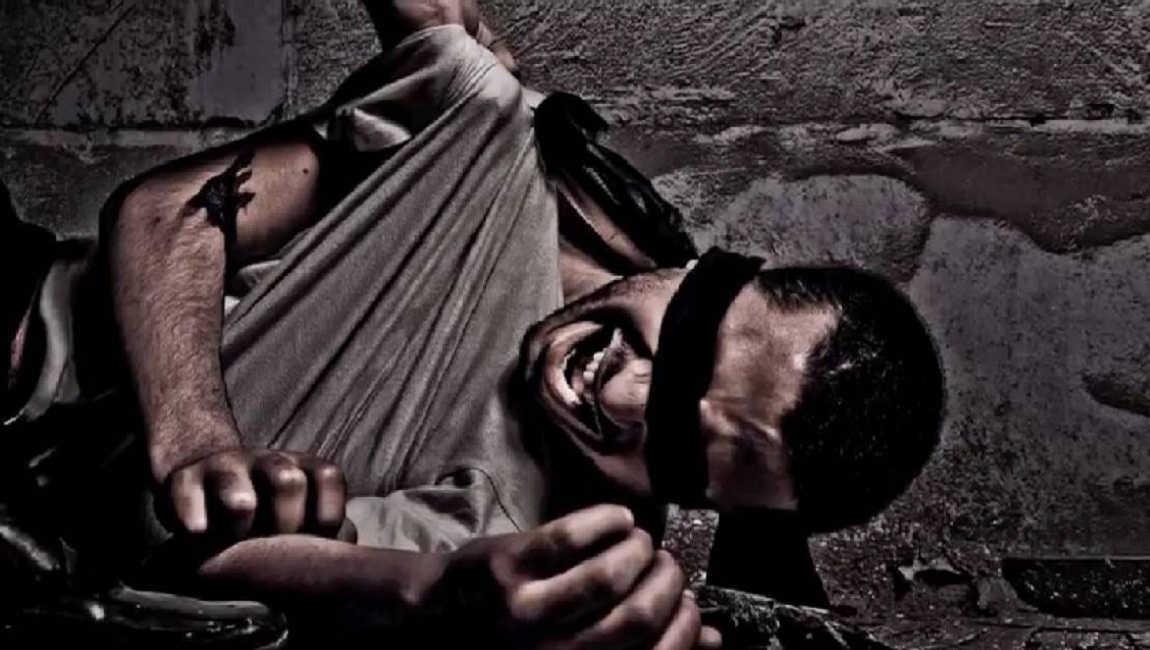
The Commission of Detainees and Ex-Detainees Affairs stated on Friday that the Gilboa Prison administration has escalated its abuse against detainees, recently employing painful electric shocks during raids on detention sections and cells.
A lawyer from the Commission, following a visit to the facility, described the procedure: special units storm the section under the pretext of conducting inspections, restrain all detainees by their hands and feet, and move them to the prison yard. There, detainees are beaten, insulted, and subjected to electric shocks.
They are then dragged to the yard showers, drenched with water, and shocked again, a method intended to intensify their pain and suffering. In many cases, detainees collapse from the ordeal.
The lawyer further noted that “the electric shocks are administered using specialized stun guns, which are also wielded as weapons to strike detainees on the head. Being made of solid metal, they cause deep wounds, leaving many detainees bleeding, while guards mock and laugh at them. The level of torture is so severe that numerous detainees lose consciousness.”
The Commission added that alongside this torture, detainees are deprived of sufficient food, receiving only minimal portions that have led to drastic weight loss.
The lack of cleaning materials and disinfectants has turned cells into breeding grounds for disease. Detainees are forced to use the same plastic plates and spoons for an entire month, ensuring the constant presence of viruses and bacteria, a situation that puts their health and lives in grave danger.
- Details
- Category: News
- Hits: 373
? The number of Palestinian detainees in Israeli occupation prisons as for the beginning of August 2025
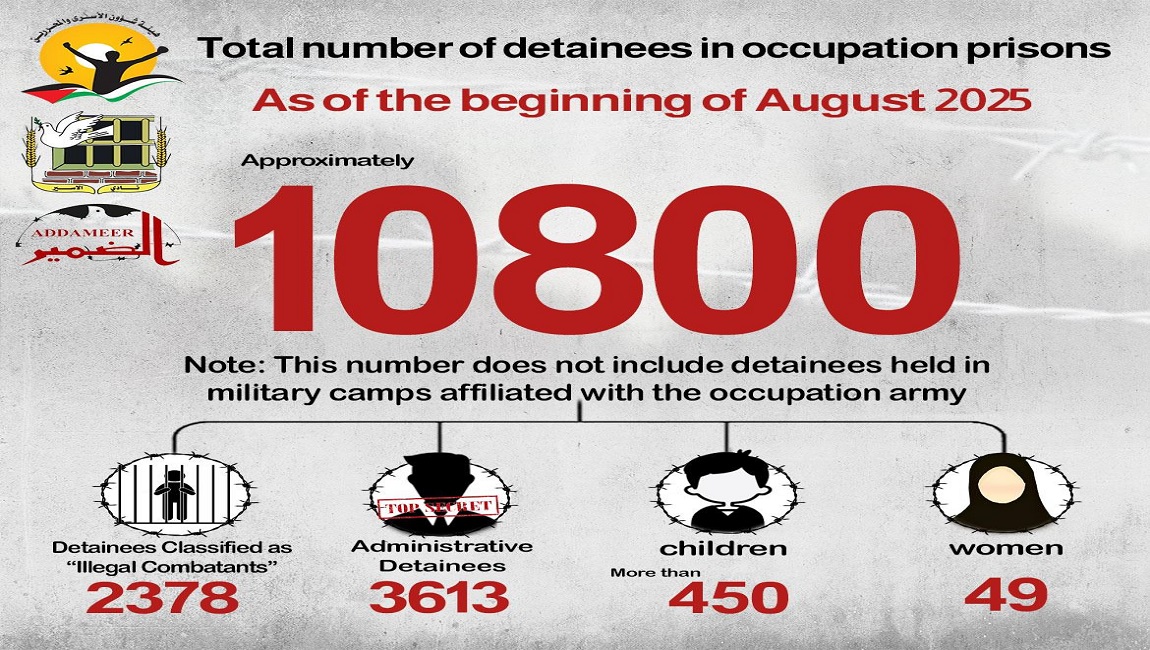
● The total number of Palestinian detainees in Israeli occupation prisons has reached nearly 10,800.
This figure does not include those held in military camps subordinate to the Israeli army, representing the highest recorded since the Second Intifada in 2000, based on detainees organizations’ documentation.
● Female Detainees : (49) women are currently held in detention, including two from Gaza.
● Child detainees: As of today, the number exceeds (450) children.
● Administrative detainees: As of the beginning of July, their number reached (3,613), representing the highest percentage compared to the number of sentenced detainees , pre-trial detainees, and those classified as "illegal combatants."
● Detainees classified as "illegal combatants": The number has reached (2,378) individuals. This figure does not include all Gaza detainees held in military camps operated by the Israeli army. It is the highest number since the beginning of the genocide war. This classification also includes Arab detainees from Lebanon and Syria.
- Details
- Category: News
- Hits: 278
Abu Al-Hummos: “Knesset's approval of the bill targeting the so-called ‘illegal combatants’ is a scandalous crime”
August 4, 2025
Raed Abu Al-Hummos, Head of the Commission of Detainees and Ex-Detainees Affairs, called on for international parliaments, legal institutions, and human rights organizations to condemn and reject the Israeli legislation that authorizes the arrest and detention of Palestinian civilians from the Gaza Strip, individuals who continue to face brutal crimes committed by the Israeli military and prison authorities.
Abu Al-Hummos stated, “For 22 consecutive months, Palestinians from across the Gaza Strip have been subjected to arbitrary arrest, systematic beatings, torture, and abuse that, in many cases, amount to execution. They are transferred from one military camp to another, from prison to prison, enduring relentless violations that are both inhumane and degrading. The occupation authorities label them as ‘illegal combatants’, as if they were foreigners who had crossed into the country from East Asia or Africa, captured at the border.”
He continued, “The Israeli Knesset, now controlled by far-right and extremist factions, is actively legalizing the detention of Palestinian civilians from Gaza. This legislation gives Israeli authorities the green light to hold detainees indefinitely without charges, without due process, and without access to legal representation. It is justified under the pretext of a so-called ‘exceptional law,’ stripping detainees of their most basic rights, including the right to be informed of the reason for their detention and the associated legal protections.”
Abu Al-Hummos pointed out that the Knesset’s general assembly recently passed this bill, targeting Palestinians arrested from Gaza since the outbreak of the war of extermination on October 7, 2023, through its second and third readings. The law was approved by a vote of 30 in favor and 6 against, out of 120 members, allowing it to take immediate effect under Israeli legislation.
He stressed that such practices and legal measures reflect utter contempt for international legal, parliamentary, and human rights systems. He called for the mobilization of all available legal mechanisms and the unification of global efforts to confront and halt this dangerous erosion of international norms.

- Details
- Category: News
- Hits: 292
Palestinian Detainee Intisar Al-Awawdeh Exposes the Inhumane Conditions Faced by Women Prisoners in Israeli Jails
August 4, 2025
The Commission of Detainees and Ex-Detainees Affairs has revealed harrowing details of the abuse endured by Palestinian women in Israeli prisons, based on the testimony of detainee Intisar Al-Awawdeh, 52, from the town of Karma near Hebron. Her account, relayed through the Commission’s lawyer after a visit to Damon Prison, sheds light on systematic violations targeting female detainees.
Arrested on May 13, 2025, Al-Awawdeh recounted that Israeli forces raided her home in the early morning hours in large numbers. Her phone and computer were confiscated, she was not allowed to change her clothes, and was blindfolded and handcuffed before being taken away in a military jeep, without the presence of a female soldier.
She described being transferred between multiple interrogation centers, including Kiryat Arba and the Moskobiyyeh, where she was subjected to a humiliating strip search and detained for 22 days in dire conditions, dim lighting, no windows, and undrinkable water.
Later, Al-Awawdeh was transferred to the Sharon transit facility, which she described as uninhabitable: damp, dirty floors, moldy walls, and foul odors emanating from every corner. Meals were barely edible and often served in unwashed dishes. In one incident, she witnessed a guard dump food remnants into the trash, bang the plate on the bin, then refill it with rice, without rinsing or cleaning it, before handing it back to her. "I was disgusted," she said, "but hunger forced me to eat a boiled egg and a single potato."
After three days, she was moved to Damon Prison, where she remains. She describes the conditions as cruel and degrading. The prison cells lack basic ventilation; air vents are sealed, and even the upper part of the door is blocked by glass and mesh. Since the events of October 7, all electric appliances, including fans, have been confiscated, leaving detainees to suffer the sweltering summer heat.
Al-Awawdeh added that daily recreation time rarely exceeds 30 minutes, and is sometimes reduced to just 15 minutes at the whim of the guards. This short window is the only time allowed for showering and washing clothes. Detainees are released in small groups to prevent interaction, and when they return, the rooms are thick with humidity, an environment she says is perfect for the spread of skin parasites. No personal hygiene supplies are provided.
On the medical front, she reported that nearly all female detainees suffer from skin irritation, heavy sweating, and digestive issues like constipation, due to poor food and lack of movement. Exercise is nearly impossible, as the yard is under constant surveillance, making it impossible for women to remove their head coverings or receive adequate sun exposure. Many detainees now suffer from vitamin D deficiency and hair loss, in addition to a severe shortage of clean clothes and undergarments.
She also highlighted the trauma caused by frequent, unannounced searches at all hours of the day and night, which heighten anxiety among the prisoners, especially minors and pregnant women.
The Commission emphasized that these conditions amount to flagrant violations of international humanitarian law, the Fourth Geneva Convention, and all universally recognized human rights standards, and called on the international community, human rights organizations, and global parliaments to take immediate action to protect the rights and dignity of Palestinian women held in Israeli prisons.

- Details
- Category: News
- Hits: 268
From Inside Negev Prison
Testimonies document starvation , medical neglect , and daily abuse
August 4, 2025
A lawyer from the Commission of Detainees and Ex-Detainees Affairs has visited a number of Palestinian detainees held in Negev Prison to assess their medical and living conditions. During the visit, he met with detainee Amro Mohammad Mansour (38 years old), from the town of Beitunia/Ramallah, who has been held under administrative detention since January 28, 2025.
Mansour stated that he was placed under administrative detention without any investigation or knowledge of the reasons for his arrest. His detention has been extended twice for 6 months and he has yet to receive a copy of the latest confirmation order.
Regarding his health, Mansour explained that he suffers from chronic migraines and has experienced repeated pain while in detention without receiving the necessary treatment, despite the prison authorities being fully aware of his condition. He also reported being infected with scabies and developing boils, yet no adequate medical care has been provided. Even when transferred to the prison clinic, his name is merely registered without receiving any real treatment.
The Commission's lawyer also visited several other detainees, who confirmed they are in stable health. They are:
1. Mohammad Raed Atoun (22 years old) from Sur Baher/Jerusalem, serving a two year sentence since January 27, 2025.
2. Ahmad Abdul Mohsen Suleiman (27 years old) from Beit 'Ur/Ramallah, held under administrative detention since June 30, 2024.
3. Yaqoub Mustafa Omar Hussein (32 years old) from Al-Jalazon Refugee Camp/Ramallah, under administrative detention since November 5, 2023.
4. Yamen Mohammad As’ad Abu Bakr (19 years old) from Ya’bad/Jenin, under administrative detention since January 15, 2024.
As for the general conditions inside Negev Prison, they are described as unprecedented. Detainees live in a constant state of fear and anxiety due to frequent transfers, the absence of stability, and the denial of the minimum requirements for a dignified life. They are subjected to degrading treatment, humiliating searches, and harsh punitive measures, including being handcuffed from behind and forced to kneel during inspections.
Food portions have been significantly reduced, and sanitation is virtually non-existent.
Moreover, rooms are overcrowded, each housing between 10 to 12 detainees, effectively turning them into prison cells. There is a severe shortage of blankets, clothing, and other basic supplies. Recreational time is granted only once every one to two weeks, for a duration of 15 to 30 minutes, barely enough time to take a shower.
The food provided is insufficient and unfit for consumption, leading to dramatic weight loss among detainees, ranging from 20 to 30 kilograms. The prison sections also lack basic necessities such as sugar, salt, tea, coffee, cigarettes, medication, canned food, and even hot water.

- Details
- Category: News
- Hits: 333
? Palestinian Political Prisoner Held Without Trial or Charge Killed in Occupation Prisons
Commission of Detainees’ Affairs & Palestinian Prisoner’s Society
August 3, 2025
Ramallah, Palestine – 20-year-old Palestinian political detainee Saeed Tazaz’a from Jenin in the northern occupied West Bank has been martyred in the Israeli occupation’s prison, Megiddo, where he was being held without trial or charge since May 6, 2025.
Occupation authorities, like in most cases, refused to provide details about how he was killed. The Commission of Detainees’ Affairs and the Palestinian Prisoner’s Society (PPS) hold the Israeli occupation fully responsible for his killing, and renew their demands for international human rights institutions to launch impartial investigations into the killings of dozens of prisoners since the start of the genocide.
Megiddo Prison is one of the most notorious Israeli prisons where serious crimes are continuously occurring.
The Commission and the PPS noted that, with the martyrdom of Tazaz’a, the number of identified martyred prisoners since the onset of the genocide has risen to 76 people, including 46 detainees abducted from Gaza. This brings the number of identified martyred prisoners since the occupation of 1967 to 313 people, making this the most violent period in the history of the prisoners’ movement.
The two institutions emphasized that the unprecedented escalation in the death toll of prisoners confirms once again that the occupation's prison system continues to implement a policy of slow killing against them. Not a month goes by without a new martyr from the prisoner movement. With the ongoing perpetration of crimes inside prisons, the number of martyrs is likely to rise as more time passes, with thousands of prisoners and detainees being held in conditions that lack the most basic necessities of life. They are subjected daily to systematic crimes, most notably torture, starvation, assaults of all kinds, medical crimes, sexual assaults, and the deliberate imposition of conditions that lead to serious and contagious diseases, most notably scabies. This is in addition to the unprecedented severity of the policies of dispossession and deprivation.
The two organizations note that while the world is demanding the release of the occupation's prisoners, it is ignoring the continued systematic killing of our prisoners and the crimes of torture that are beyond description.
The international human rights system must take effective decisions to hold the occupation leaders accountable for the war crimes they are committing against our people, and to impose clear sanctions that isolate the occupation internationally, restore the human rights system to its fundamental role for which it was established, put an end to the terrifying state of impotence that afflicted it during the war of extermination, and end the state of exceptional immunity that the world grants to the occupying state, as if it is above the law, accountability and responsibility.
- Details
- Category: News
- Hits: 299
On the National and Day of Solidarity with Gaza and the Detainees
● This report presents key figures related to the wave of arrests since the onset of Israel’s war of extermination, including updated statistics on the number of Palestinian detainees held in Israeli prisons.
Palestinian detainees institutions have documented the scope of arrest campaigns across the occupied territories, particularly in the West Bank and Jerusalem. Since the beginning of the war, approximately 18,500 arrests have been recorded, this number excludes the thousands detained in Gaza.
Women: Since October 7, around (570) women have been arrested, including women from the occupied West Bank, the Gaza Strip (those detained in the West Bank), and the 1948 territories. The actual number of women detained from inside Gaza is believed to be in dozens, but remains unconfirmed.
Children: At least (1,500) children have been arrested in the West Bank alone.
Journalists: Over 194 journalists have been arrested or detained since the start of the war. As of now, 49 remain imprisoned.
The arrest campaigns have been accompanied by severe violations and acts of violence, including physical assaults, torture, threats against detainees and their families, the looting and destruction of property, and widespread damage to civilian homes and infrastructure. Vehicles, personal funds, and gold have also been confiscated. Entire neighborhoods, particularly in the refugee camps of Tulkarm and Jenin, have suffered from systematic demolition. In some cases, family members of detainees have been held as hostages, and detainees have been used as human shields.
These figures cover arrests carried out in homes, at military checkpoints, those who were coerced into surrendering, and individuals held as hostages.
In parallel with these campaigns, Israeli forces have conducted extrajudicial executions, including targeting relatives of detainees.
It is important to note that statistics related to the West Bank include individuals who remain in detention as well as those who have since been released.
. Since October 7, at least (75) Palestinian detainees have died in Israeli custody, with their identities officially confirmed and publicized.
Among them are (46) detainees from Gaza. Dozens more from Gaza have died in prisons and military camps under conditions of enforced disappearance, with Israeli authorities concealing their identities and the circumstances of their deaths. Additionally, many were executed in the field.
Israel continues to withhold the bodies of (72) detainees confirmed to have died since the start of the war. These individuals are among (83) martyrs whose remains are still being held by the occupation.
Due to Israel’s policy of enforced disappearance, the full number of Gaza detainees is unknown. However, Israel has acknowledged detaining thousands of Palestinians from Gaza, many of whom were later released. These include workers who had entered the 1948 territories with official permits, hundreds of laborers detained in the West Bank, and civilians who were in the West Bank for medical treatment.
Total Number of Palestinian Detainees in Israeli Prisons/As of July 2025
According to the latest verified data, the number of Palestinian detainees in Israeli prisons has reached approximately (10,800), the highest figure recorded since the Second Intifada in 2000.
Female detainees: There are currently 49 women in Israeli custody, including two from Gaza.
Child prisoners: The number of detained children exceeds 450.
Administrative detainees: As of early July, there were (3,629) Palestinians held without charge or trial, an unprecedented figure compared to other detainees categories, including pre-trial, sentenced, and “illegal combatants.”
Detainees labeled as “illegal combatants”: This category includes (2,454) individuals, though it does not account for all Gaza detainees held in military camps. It is the highest number recorded since the beginning of the war. This classification also includes Arab detainees from Lebanon and Syria.
Note: These figures are subject to daily change due to the ongoing arrest campaigns. They reflect both current detainees and those who have been released.
Issued by Commission of Detainees’ Affairs and the Palestinian Society Prisoner’s Club

- Details
- Category: News
- Hits: 277
Testimonies of Torture: Occupation Soldiers Force Palestinian Detainees to Drink Alcohol, Pour Boiling Water on Them
Issued by the Commission of Detainees’ Affairs and the Palestinian Prisoners' Society
Thursday, July 24, 2025
Ramallah, occupied Palestine – Following lawyers’ visits to several Israeli occupation prisons in July 2025, the Commission of Detainees’ Affairs and the Palestinian Prisoner’s Society (PPS) publish a short report highlighting the horrific testimonies gathered from Palestinian political detainees abducted from the occupied Gaza Strip.
These testimonies once again reflect the unprecedented level of crimes they endured during their arrest and interrogation, in addition to their current conditions of detention, which include severe medical violations, systematic starvation, and continuous assault and abuse inside detention centers and camps that have resulted in the killing of dozens of detainees while many others remain victims of enforced disappearances.
The legal teams obtained these brief testimonies during visits to the following detention centers: Naqab (Negev), Ofer, Sde Teiman, and the Russian Compound (Al-Maskoubiyyeh) in occupied Jerusalem.
One testimony included an account of guards pouring boiling water on a detainee’s body, while another described being forced to strip naked and then violently beaten. One detainee reported being forced to drink alcohol, and another was subjected to psychological torture that led him to attempt suicide after an interrogator falsely informed him that his family had been killed — only to later learn that his family was safe. Another detainee was attacked by a police dog, resulting in injury.
Detainee (M.Y): "They poured boiling water onto my body"
"I was arrested in February 2024 and subject to field interrogation, then transferred to Sde Teiman military camp for 25 days, then to a camp near Jerusalem, later to Ofer Prison, and then to Naqab Prison. Throughout this period, I was subjected to all forms of torture. When I was transferred to Naqab Prison, boiling water was poured onto my body.
Today I am held in the tent section of the Naqab Prison, where 27 detainees are held in each tent in extremely harsh conditions. We suffer from constant assault, starvation, and daily humiliation. The food is inedible, so we are forced to fast all day and save it for one meal in the evening. We are also denied treatment, even for scabies, which many detainees have contracted and which has worsened due to the lack of hygiene and the absence of preventive and curative measures."
Detainee (M.Y): "I was stripped naked and forced to drink alcohol"
"I was arrested in February 2024 from the safe passage in Gaza, then transferred to the Gaza envelope area for 25 days, and after that to a camp near Jerusalem, then to Ofer Camp, where I stayed for 60 days, and then to Naqab Prison. In the Gaza envelope, I was beaten with a sharp object, and my wound required [surgical] staples which remained in my head for 119 days, causing a scalp infection. In the camp near Jerusalem, I was completely stripped and forced to drink alcohol."
Detainee (H.N): "I attempted suicide after the interrogator told me my family [in Gaza] had been killed"
"I was arrested in December 2024 via the [Israeli army] Civil Administration checkpoint. I was severely beaten and stripped of my clothes. The interrogator told me that the occupation army had killed all my family members, which caused me a severe psychological crisis that drove me to attempt suicide inside the cell. I would have died if not for the intervention of my fellow detainees. During my visit, the lawyer told me that my family is fine. I broke down in tears and couldn’t believe what I heard."
Detainee (H.D): "We live in constant fear and terror around the clock"
"I was arrested in October 2024 via the [Israeli army] Civil Administration checkpoint. I was subject to field interrogation, then held in the barracks in the Gaza envelope for 110 days before being transferred to Naqab Prison. We continue to live under extremely harsh conditions, facing daily inspections, assaults, and humiliation. They force us to sit on our knees with our hands behind our backs during what they call the 'count – security check.' Diseases are widespread, and fear and terror never leave us, in addition to being denied medical treatment and deliberately starved."
Detainee (A.W): "I suffered severe eyesight damage due to beatings"
"I was arrested in February 2024 from a school in Khan Younis, where the occupation army arrested more than 100 citizens. I was transferred to the barracks for 23 days, then to a detention center near Jerusalem, then to Ofer Prison, and later to Naqab Prison. During the transfer from Ofer to Naqab, I was struck on the head with handcuffs, which caused severe impairment in my left eye, persistent headaches, and loss of balance. I also contracted scabies, which returned after I recovered due to the unsanitary conditions."
Detainee (Kh.Y): "My leg was broken and I received no treatment"
"I was arrested in December 2023 from a school in the Shuja'iyya neighborhood after displacement. I was transferred to the barracks in the Gaza envelope, then to Naqab Prison. During the arrest, I was severely beaten, which caused a fracture in my right ankle joint. I did not receive any treatment despite the intense pain — not even painkillers. I suffer from difficulty walking and constant pain."
Detainee (H.R): "I was attacked by a police dog that tore into my foot"
"I was arrested in October 2024 from Rafah and subject to field interrogation, then stripped of my clothes. A police dog attacked me and bit into my foot. I was later transferred to the Gaza envelope, where I was subjected to 'disco interrogation' method* and other interrogations by intelligence officers, then to Ofer camp, and then to the Russian Compound (Al-Maskoubiyyeh) cells, where I was placed in solitary confinement for four months and subjected to military interrogations in Asqalan. Just a week ago, I was brutally beaten with batons."
*Disco interrogation is a method employed by the Israeli prison forces and was used in Guantanamo to pressure to detainees to make confessions, in which they expose the detainee to very loud music or sounds for prolonged periods of time causing disorientation.
Key Facts About Palestinian Political Detainees Abducted From Gaza:
- Since the genocide in October 2023, human rights organizations have been unable to obtain the exact number of those abducted from Gaza due to the crime of enforced disappearance. However, the number is estimated to be in the thousands.
- The testimonies of detainees taken from Gaza are the most severe, given the scale of crimes committed against them.
- The Israeli occupation has established new camps specifically for holding detainees abducted from Gaza. The most prominent include: Sde Teiman, Anatot, Ofer Camp, Naftali, and the Rakevet section under Ramla Prison.
- The majority of detainees taken from Gaza are held in Naqab Prison and Ofer Prison/Camp.
- According to the Israeli Prison Service, as of early July 2025, the number of Gaza detainees classified as "unlawful combatants" (held without trial or charge) reached 2,454 people— the highest figure recorded since the beginning of the genocide. This number doesnot include those held in army camps, but only those under the management of the Israeli Prison Service.
- The "Unlawful Combatant Law" serves as a main tool for legitimizing the crime of enforced disappearance. It also fundamentally violates international law in both its structure and substance and facilitates the widespread use of torture against Gaza detainees.
In this context, the Commission of Detainees’ Affairs and the Palestinian Prisoners’ Society affirm that the occupation continues its extermination and crimes in full view of the world, without any meaningful change that might contribute to halting the genocide and the comprehensive aggression against our people. One form of this is the ongoing crimes against prisoners and detainees. Moreover, the continued passage of time while the genocide goes on means that the state of paralysis afflicting human rights organizations has gone beyond mere failure — prompting a necessary question about the purpose of the human rights system itself, especially as the reality of Israeli exceptionalism on the international stage continues to expand.
----ENDS---