

- Details
- Written by: Sanaa
- Category: Report and achivements
- Hits: 843
Electroshocks & Starvation: Escalating Torture of Palestinian Political Prisoners by the Israeli Occupation’s Prison System
November 27, 2025
Briefing by the Palestinian Prisoner’s Society & the Commission of Detainees’ Affairs based on lawyers’ visits conducted during November 2025
Ramallah, occupied Palestine - The Israeli occupation’s apparatus of brutality continues to commit serious crimes against Palestinian political prisoners – forming another facet of the ongoing genocide in occupied Gaza. Acts of torture, abuse, starvation, and severe assault persist at unprecedented levels since the start of the genocide.
Lawyers of the Commission of Detainees’ Affairs and the Palestinian Prisoner’s Society carried out dozens of visits to political prisoners during the month of November 2025, and prepared this report, which includes testimonies, on the horrific maltreatment and overall conditions for detainees.
The prisons that were visited include: the Naqab, Ofer, Damon, Shatta, Megiddo, Gilboa, Ofer Camp (Gilad), Janout (formerly Ramon and Nafha) as well as the Rakevet underground section of Ramla Prison. The two organizations documented an escalation in the scale of attacks—particularly through the use of electric shocks, rubber-coated bullets, and the exploitation of injuries suffered by the wounded – further torturing them by denying them medical treatment.
This briefing comes at a time when the occupation is seeking, at an accelerated pace, to legalize the execution of Palestinian prisoners—one of the most dangerous legislative proposals it has attempted to impose throughout its history.
Full report in English below??
Electroshocks & Starvation: Escalating Torture of Palestinian Political
Prisoners by the Israeli Occupation’s Prison System
Briefing by the Palestinian Prisoner’s Society and the Commission of Detainees’ Affairs based on lawyers’ visits conducted during November 2025
Published November 27, 2025
Ramallah, occupied Palestine - The Israeli occupation’s apparatus of brutality continues to commit serious crimes against Palestinian political prisoners – forming another facet of the ongoing genocide in occupied Gaza. Acts of torture, abuse, starvation, and severe assault persist at unprecedented levels since the start of the genocide.
Lawyers of the Commission of Detainees’ Affairs and the Palestinian Prisoner’s Society carried out dozens of visits to political prisoners during the month of November 2025, and prepared this report on the horrific maltreatment and overall conditions for detainees.
The prisons that were visited include: the Naqab, Ofer, Damon, Shatta, Megiddo, Gilboa, Ofer Camp (Gilad), Janout (formerly Ramon and Nafha) as well as the Rakevet underground section of Ramla Prison. The two organizations documented an escalation in the scale of attacks— particularly through the use of electric shocks, rubber-coated bullets, and the exploitation of injuries suffered by the wounded – further torturing them by denying them medical treatment.
Diseases continue to rise, and the general health conditions and immunity of the prisoners continue to deteriorate, with the renewed spread of Scabies skin disease in several prisons and the registration of hundreds of new cases.
This briefing comes at a time when the occupation is seeking, at an accelerated pace, to legalize the execution of Palestinian prisoners—one of the most dangerous legislative proposals it has attempted to impose throughout its history. Today, in the context of the ongoing genocide inside the prisons, and as part of a series of legislations targeting Palestinian existence, the occupation—which for many decades has carried out extrajudicial executions through various policies, including slow killing that has affected hundreds of prisoners and detainees—is working to formalize and officially legalize executions.
Gilad Military Camp in Ofer Prison: Widespread Use of Electro-Shocking
The recently established Gilad Military Camp within Ofer prison, holds more than 120 newly detained Palestinian political prisoners. Detainees held there face harsh detention conditions and systematic abuse. Detainee testimonies showed that electro-shocking has become a primary tool used to torture them.
In one testimony, a detainee reported that another prisoner was electroshocked after prison forces saw him leading other detainees in prayer inside the room. Other detainees also reported being subjected to physical attacks, electric shocks, and abuse because some prisoners stood near the barred windows inside the cells in an attempt to breathe some air. They described electric shocking as one of the harshest and most severe methods used against them.
Among other forms of abuse practiced against detainees is forcing them to sleep on “alabraash”—beds made of iron bars over which very thin mattresses are placed, causing harm to their bodies. For this reason, most prisoners prefer to sleep on the floor; however, with the arrival of winter and the intensifying cold at night, their suffering has increased. It is worth noting that the camp administration removes blankets and mattresses during the morning inspection at 6am, preventing the prisoners from sitting or lying down until 10pm at night.
The detainees also indicated that the “head-count”, or what is called the security check, is exploited as a tool of abuse, during which they are forced to kneel on the ground and raise their hands above their heads until the procedure is over.
All detainees reported suffering from hunger, as they are given food that is inedible and often spoiled.
During their transfer to lawyers’ visits, detainees are brought handcuffed and shackled, forced to place their cuffed hands above their heads, blindfolded, and required to keep their heads lowered.
The “Rakevet” Underground Section of Ramla Prison
The testimonies of Palestinians abducted from occupied Gaza remain the harshest and most severe since the beginning of the genocide, based on dozens of visits carried out in several prisons and camps.
Three meals are provided consisting of only small, minimal portions. Mattresses are distributed only from 11pm to 4am, and during the daytime detainees are forced to sit on the iron bars of the beds. Collective prayer is prohibited and only individual prayer is allowed. Possession of the Qur’an is not permitted.
Beatings and repression by special prison forces continue, and during the recreation period detainees are shackled and forbidden from lifting their heads. Verbal insults and degradation are constant, along with ongoing threats—especially before they are taken to lawyers’ visits, during which they are forbidden from speaking about what occurs inside the section or about the abuses they face. They are also prevented from receiving any information about what is happening outside the prison.
Testimonies of Palestinians Abducted from occupied Gaza Held in “Rakevet”:
Detainee (A.M.):
“I was arrested at the checkpoint while passing from Khan Younis toward Al-Mawasi. I was interrogated in the field and beaten. Although I have cancer, they continued to detain me and transferred me to the barracks with dozens of other prisoners. Later, I was moved to Asqalan Prison, where I underwent interrogation about five times. After the interrogation ended, I was transferred to the Rakevet section, where I remain held to this day without receiving any treatment or medical care.”
Detainee (N.R.):
“I was arrested in December 2023 in Jabalia. I was not subjected to field interrogation; I was taken directly to the barracks. There, I underwent military interrogation for eight consecutive days, during which I was subjected to shabeh (stress positions) and beatings—specifically the ‘banana’ position—as well as the ‘disco’ interrogation method. Then I was transferred to
Asqalan Prison in April 2024 and interrogated again for 25 days. Later, I was moved to the Rakevet section. Today I suffer from chest pain due to the beatings I endured during my transfer to the section.”
Detainee (M.N.):
“I was arrested in November 2023 at the Netzarim checkpoint. I was interrogated in the field for hours and beaten. Then I was taken to the barracks, where I was tortured. I was taken and tied in a stress position to the fence for nearly an hour (shabeh). Later, I was transferred to the Ofer cells and subjected to continuous military interrogation, during which they used shabeh, beatings, and the ‘banana’ position, which caused a fracture in my back. Afterward, my statement was taken and I was moved to the ‘asafeer’ section (informants). Two days later, I was placed in solitary confinement, where I was tortured and threatened. Due to the continuous handcuffing, my hands changed color, and today I suffer from impaired vision and constant back pain resulting from the fracture.”
Naqab Prison: One of the Worst Central Prisons; Atrocities Intensifying
Naqab Prison remains one of the central facilities where horrifying testimonies and torture practices have been documented, and where several detainees have died. More than two years into the Gaza genocide, the catastrophic reality inside the prison is only getting worse— including systematic repression by prison special forces termed “Keter” - as well as the firing of rubber-coated bullets at detainees inside their cells and during their time in the prison yard.
In addition, the spread of scabies has continued, turning into yet another tool of torture and mistreatment within the prison system. Cases have risen sharply, to the point where they can no longer be counted. Even when legal teams succeed in securing a decision to transfer sick prisoners to the clinic, the occupation’s prison administration only provides a superficial service and forces the detainees to sign papers stating they received treatment, while in reality they receive no medical care and instead face humiliation and abuse during the transfer process.
Once again, prisoners confirmed the continuation of systematic abuse during the “security check – headcount,” in which they are forced to kneel, place their hands above their heads, and lower their heads downward. Each prisoner is also required to sit in a small designated space inside the cell and is beaten and abused if he exceeds it.
Prisoners recounted one recent repression operation that was carried out after a plastic wrapper was found inside one of the cells—detainees were assaulted, beaten, and denied access to the prison yard. Their suffering has worsened with the arrival of winter and the intensifying cold, especially at night, as the administration continues to deprive them of blankets and adequate clothing.
As for the crime of starvation, it continues to escalate, with further reductions in the already minimal food portions. Despite the occupation’s High Court ruling that the food provided to prisoners must be reassessed, the prison system has disregarded the decision altogether and has in fact reduced food quantities even further.
Ofer Prison: Widespread Outbreak of Scabies and Escalating Raids
During November, dozens of prisoners were visited in Ofer Prison, one of the main facilities holding thousands of political prisoners and detainees. According to numerous testimonies, the spread of Scabies is a central issue, especially after it widely infected even the section allocated for child prisoners.
Despite the occupation’s prison administration’s claim that it provides treatment consisting of an ointment and a pill, the reality is entirely different. A single tube of ointment distributed to dozens of prisoners does not constitute real treatment, as each prisoner needs more than one tube to receive adequate care. With the infection spreading across their bodies and causing boils, prisoners can no longer stand, move, or sleep.
The outbreak at this scale is linked to a series of other oppressive policies, including:
• Depriving prisoners of adequate amounts of clothing
• Depriving them of hygenic products both individually and for the cell
• Weakened immunity resulting from the crime of starvation
• Lack of exposure to fresh air or sunlight
• Continued confinement in overcrowded cells
Beyond diseases, physical attacks do not stop. Systematic raids and searches continue, during which rubber-coated bullets are fired and police dogs are used. In November, one of the cells was subjected to a raid after the administration discovered that prisoners possessed plastic bags they had used to cover the barred, open windows due to the severe cold.
Details relayed by three prisoners in lawyers’ visits:
• One child detainee suffers from severe chest pain as a result of repeated repression operations targeting children, accompanied by beatings, stun grenades, and police dogs.
• Another detainee reported that October 2025 witnessed a significant escalation in repression operations, during which prisoners were beaten with batons and shot with rubber-coated bullets. Repression forces deliberately carry out their assaults during the morning count.
• The third detainee said that due to the pressure and harsh conditions of detention, he has begun experiencing repeated seizures during which he loses consciousness—even losing consciousness while being transported to a court hearing. Recently, these seizures have been occurring at least three times a week, leaving him with severe pain in his limbs.
Megiddo, Gilboa, Shatta, and Janout Prisons
All testimonies of detainees in these prisons indicated new cases of scabies, along with the prison administration’s deliberate reduction of food portions and the continuation of repression and assaults. The most striking development in these prisons, however, is the rise in medical cases; most of those visited suffer from health problems and require urgent treatment, especially the wounded.
Prisoner (D.N.) sustained a head injury two months before his arrest and suffered significant damage to his face. He was supposed to undergo eye surgery before being detained, but this never happened. Today, he suffers from severe pain, and a piece of shrapnel remains lodged in his head that must be removed. Like thousands of others, he is denied treatment despite repeated appeals.
Prisoner (M.R.) suffers from an injury to his foot by occupation forces during a previous arrest. When he was re-arrested in 2023, he was assaulted, causing the metal plates placed in his feet to break. He now suffers from intense pain, yet the prison administration refuses to provide treatment or even conduct an examination to assess the damage caused by the assault.
Prisoner (A.D.) had previously been injured by gunfire in his foot and was supposed to undergo bone graft surgery, but the prison system denied him this medical care. He now suffers from severe, continuous pain and relies on a crutch to move. His suffering intensified after the prison administration confiscated the crutch from him.
These testimonies clearly show how the prison system uses prisoners’ injuries and medical needs as tools of abuse and torture by denying them treatment.
It is also noted that large-scale transfers have affected hundreds of prisoners, especially from Megiddo Prison to Naqab Prison.
In Janout Prison, one of the prisoners who was visited was violently assaulted while being taken to a visit; he was severely beaten, insulted, and shackled in a manner that tormented him.
Damon Prison (Females only)
More than 50 female prisoners are currently held in Damon Prison, including one from Gaza and two girls. The women prisoners, like all other prisoners, continue to face a series of systematic abuses, including repeated repression, strip-searches, beatings, as well as systematic deprivation of basic necessities.
The women’s testimonies focused heavily on the urgent need for healthcare, especially with the presence of serious medical cases, most notably prisoner Fidaa Assaf, who suffers from cancer, and another newly-detained prisoner who also has cancer, Suheir Al-Za’aqiq, who was recently arrested from Beit Ummar/Hebron during the large-scale arrest campaign carried out in the town.
Many of the women also spoke of the harsh and oppressive conditions they faced during the interrogation period before being transferred to Damon Prison, with some undergoing interrogation for over a month. Their special needs constituted one of the main issues they raised, including the severe shortage of sanitary pads, as well as their need for a gynecologist to follow up on numerous health problems that have worsened due to the harsh detention conditions and weakened immunity resulting from starvation.
In their testimonies, female prisoners also expressed the severe psychological challenges they face under the oppressive isolation conditions—one of the most dangerous and harmful policies affecting their mental health. This burden is only compounded by the ongoing denial of family visits, especially for imprisoned mothers who were torn from their homes and deprived of their children.
It is noted that the vast majority of the women are detained on charges the occupation labels as “incitement,” in addition to several who are held under administrative detention.
Data on Palestinian Political Prisoners in November 2025
As of November 2025, the number of Palestinian political prisoners and detainees held in the Israeli occupation’s prisons exceeds 9,250 people, the majority of whom are detainees awaiting trial and ‘administrative detainees’ (those denied trial or formal charges). This figure does not include detainees held in military camps under the authority of the occupying army and not the central prison system.
• According to figures announced by the Israeli Prison Service up to November 2025, the number of sentenced prisoners reached 1,242 people.
• At least 50 Palestinian women, including one from Gaza, are held behind bars.
• At least 350 Palestinian children are held in Ofer and Megiddo prisons.
• At least 3,368 Palestinians from the occupied West Bank are held without trial or charge also known as “administrative detainees.”
• The number of detainees abducted from occupied Gaza and are held under the “unlawful combatants” law has reached 1,205 people, noting that this figure does not include all Gaza detainees held in army-run camps who fall under this classification. This category also includes Arab detainees from Lebanon and Syria.
• The occupation acknowledged that 94 Palestinian prisoners have been martyred in its prison system and military camps up to August 2025. Detainees institutions have documented and identified 81 of those people. With four additional detainees announced killed after August, this means the number of prisoners who were killed in custody exceeds 100 people.
Key Demands:
• States must comply with the advisory opinion of the International Court of Justice and activate its findings regarding the illegality of the occupation, and to demand the immediate dismantling of the military court system.
• The Independent International Commission of Inquiry established by the Human Rights Council must investigate all abuses against prisoners and detainees, including torture, extrajudicial killings, field executions, and sexual violence, and to hold those responsible accountable under international humanitarian law and international human rights law.
• States must condemn and act against the proposed law to execute prisoners, as it effectively legalizes extrajudicial execution; International action must halt these draft laws and hold those responsible accountable.
• The crimes committed by the occupation must be referred to the International Criminal Court (ICC) as war crimes and crimes against humanity, and ensuring that perpetrators do not escape accountability.
• Activating universal jurisdiction against those responsible for violations, including political, security, and administrative leaders, as well as members of the Knesset who vote for discriminatory laws.
• Imposing sanctions on and boycotting the occupyping state.
• Enabling specialized international bodies—including the International Committee of the Red Cross and UN Special Rapporteurs—to access prisons without restrictions and to receive testimonies in a safe and transparent manner.
(ENDS)
- Details
- Written by: Sanaa
- Category: Report and achivements
- Hits: 939
Update on the number of detainees in Israeli occupation prisons
November 2025
- This data is based on information published by detainees’ institutions and what has been announced by the Israeli Prison Service as of November 2025.
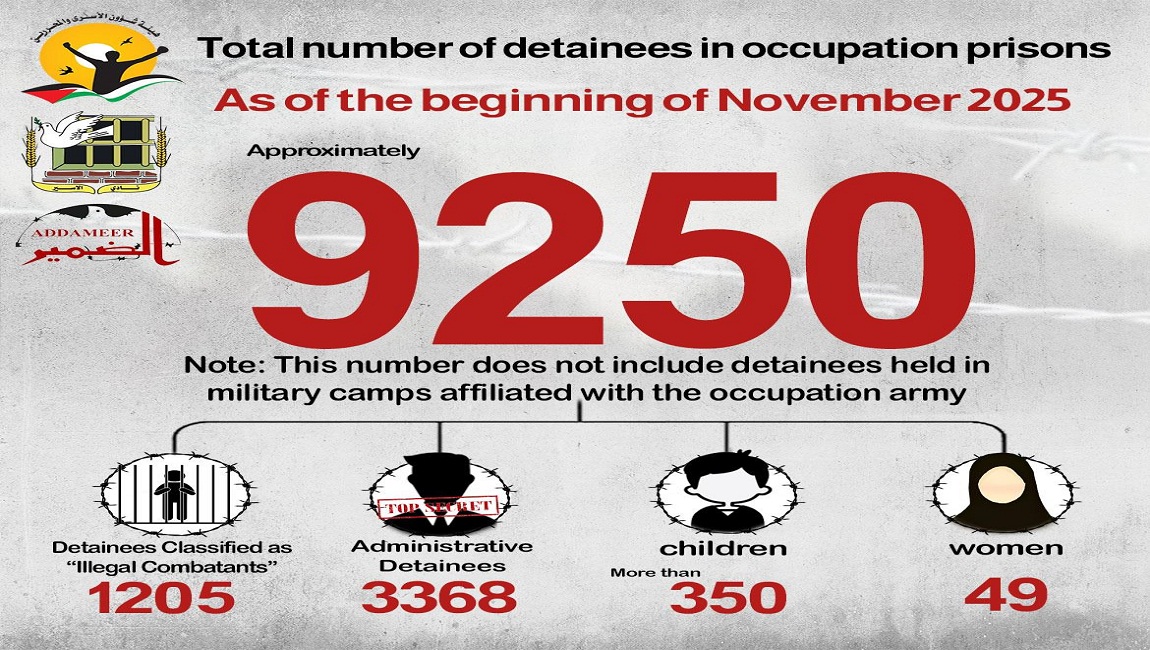
- The number of detainees held in Israeli occupation prisons has exceeded 9,250, the majority of them are detainees held under administrative detention and those who still under arrest. It is important to note that this figure does not include those held in military camps subordinate to the Israeli army.
- According to the Israeli Prison Service, as of November 2025, the number of sentenced detainees reached 1,242.
- The number of female detainees stands at 49, including one woman from Gaza.
- The number of minor detainees has reached 350, held in Ofer and Megiddo prisons.
- The number of administrative detainees stands at 3,368.
- The number of detainees classified as “unlawful combatants” stands at 1,205. This figure does not include all detainees from Gaza who are held in army camps under this same classification. It is worth noting that this category also includes Arab detainees from Lebanon and Syria.
Detainees’ Institutions
- Details
- Written by: Sanaa
- Category: Report and achivements
- Hits: 1203
Prisons as a Frontline of Genocide: Two Years of War Crimes Against Palestinian Political Detainees
Palestinian Prisoner’s Society, Commission of Detainees’ Affairs, and the Addameer Prisoner Support and Human Rights Association
October 7, 2025
Ramallah, occupied West Bank - Two years into the Israeli occupation’s genocide in Gaza and its widespread assault across historic Palestine, the Palestinian Prisoner’s Society, the Commission of Detainees’ Affairs, and the Addameer Prisoner Support and Human Rights Association present a report on the condition of Palestinian political prisoners. This includes critical data and an overview of the ongoing violence inside Israeli occupation prisons—an extension of the broader campaign of erasure and genocide of Palestinians.
Since the start of the genocide, detainees have been subjected to deliberate killings inside prison walls. Some have been beaten to death, while others have died due to systemic denial of medical care, starvation, and other inhumane practices. These abuses, though not new, have intensified dramatically, resulting in the highest recorded number of killings of Palestinian prisoners in recent history.
At least 77 Palestinian political prisoners have been confirmed killed since the genocide began, while dozens of detainees abducted from Gaza remain forcibly disappeared, with their bodies withheld by the occupation. These crimes reflect a broader pattern of settler-colonial violence and systematic attempts to destroy Palestinian prisoners.
Full report in English below
Prisons as a Frontline of Genocide: Two Years of War Crimes Against Palestinian Political Detainees
Fact Sheet by the Palestinian Prisoner’s Society, Commission of Detainees’ Affairs, and the Addameer Prisoner Support and Human Rights Association.
October 7, 2025
Ramallah, occupied Palestine - Two years since the start of the Israeli occupation’s escalating genocide against our people in the Gaza Strip, and the comprehensive aggression across historic Palestine, the Palestinian Prisoner’s Society (PPS) and other prisoner institutions present a fact sheet on the issue and reality of political prisoners. This includes key data and figures as well as an overview of the horrific conditions in the Israeli occupation’s prisons which constitute one aspect of the genocide, whereby Palestinian political detainees are being subject to unprecedented settler-colonial violence and erasure.
Over the past two years, detainees have been exposed to deliberate murder behind bars at the hands of the Israeli occupation’s prison services. This includes direct killing such as beating detainees to death, and other indirect killings through inhumane policies including denial of the right to medical care and starvation. These actions, which existed before but intensified greatly since the genocide in Gaza, have led to a record number of Palestinian political prisoners killed. There have been 77 identified murdered Palestinian political prisoners since the genocide began, while dozens of other detainees abducted from Gaza were martyred and their bodies remain withheld by occupation authorities and subject to enforced disappearances.
This figure stands as irrefutable evidence of one of the most brutal periods in the history of the Palestinian prisoner movement, which has long resisted a prison system designed to physically and psychologically destroy detainees.
Relying on hundreds of documented testimonies, material evidence, and public threats by Minister Itamar Ben Gvir and the far-right Israeli government, the PPS and other institutions affirm that the crimes against prisoners constitute large-scale war crimes and crimes against humanity. The Israeli judicial system, including its Supreme Court, has provided legal cover for this brutality.
These crimes include torture, killing, looting, starvation, the intentional spread of disease, denial of medical care, sexual assaults including rape, and collective isolation — all aimed at the systematic killing of Palestinian prisoners. The scale of violence over the past two years has exceeded all legal definitions, violating international laws and conventions, amid unprecedented global inaction — especially due to the protection granted to these crimes by international powers, chiefly the United States.
Nevertheless, as human rights institutions, and despite the bleakness of the reality, we cannot ignore the role of principled human rights advocates, nor the importance of activating international decisions that support our people’s right to freedom and self-determination.
While the occupying state continues to commit its ongoing crime of genocide over the past two years, we are now witnessing the continued detention of dozens of activists from the Sumud Flotilla who, in their testimonies, revealed that they were subjected to abuse, ill-treatment, and detention under harsh conditions. This has been accompanied by public threats made by the Ben Gvir against the activists, whom he described as “terrorists.” In this context, the institutions express their salute to all the activists who attempted to break the siege imposed on our people in Gaza.
Key Policies and Violations Documented by Prisoner Rights Institutions
We have documented an unprecedented escalation in the scale and scope of systematic crimes and violations widely practiced against Palestinian political prisoners since the beginning of the genocide. Among the most prominent of these crimes are:
- Torture in all its physical and psychological forms.
- Systematic starvation and denial of sufficient and balanced food.
- Medical crimes, including denial of treatment and deliberate imposition of conditions that lead to the spread of diseases and epidemics.
- Collective isolation and policies of deprivation affecting all aspects of prison life.
- Systematic repression and attacks carried out by special units of the Israeli Prison Services, notably the Keter, Metzada, and Nahshon units.
- Violent physical assault, including the use of gas, stun grenades, and electroshock weapons.
- Policies of humiliation, including strip searches and sexual assault, including rape.
- Using illness as a tool of torture, as seen in the outbreak of scabies skin disease.
- Psychological terror, solitary confinement, and threats of murder.
- Enforced disappearance has also become a policy, particularly targeting detainees from Gaza.
Additionally, there has been a massive surge in the use of the policies of “administrative detention” and “unlawful combatants” both of which allow detention without trial or charge for indefinite periods without due process.
Martyred Prisoners: The Most Violent Era in the History of the Prisoner Movement
The number of martyred Palestinian political prisoners whose identities have been confirmed has reached 77 people, all of whom were killed through either torture, starvation, or denial of medical treatment, or a combination of them all. These are only those whose identities have been revealed; the bodies of dozens of detainees from Gaza who have been killed remain forcibly disappeared.
In addition, occupation authorities continue to withhold the bodies of 85 martyred prisoners who were killed in detention, 74 of whom were martyred since the start of the genocide.
The total number of martyrs of the Palestinian prisoner movement since the occupation of 1967 is estimated at 314 people, according to documentation compiled over the decades.
We emphasize here that the occupation’s claims of opening “investigations” into the circumstances of some prisoner deaths and killings — following formal requests from certain human rights institutions — are nothing more than a policy of deception and deliberate stalling.
The Case of Palestinians Detained from Gaza
The testimonies and accounts of detainees from Gaza have marked a pivotal shift in understanding the level of brutality practiced by the occupation system. These testimonies have revealed an unprecedented pattern of systematic torture, beginning from the moment of arrest, through the stages of interrogation, and continuing into prolonged periods of detention.
The methods of repression and abuse have varied, ranging from physical and psychological torture, to beatings, starvation, and deliberate medical crimes — in addition to sexual assault. Taken together, these acts constitute a fully developed policy of extermination and genocide inside prisons and military camps.
These crimes have led to the killing of dozens of detainees, alongside field executions carried out by occupation forces during arrest. According to official data, human rights organizations have so far identified 46 martyred Palestinians among those abducted from Gaza, out of a total of 77 prisoners killed since the start of the genocide. Meanwhile, the occupation continues to conceal the fate of dozens of other martyred Gaza detainees.
It is also worth noting that the occupation authorities have established several camps and special sections inside prisons specifically for Gaza’s detainees. Most notable among them is the Sde Teiman camp, which has become a central site of torture and killings, and the Rakevet section, located underground in Ramla Prison, which stands as a stark example of enforced disappearance and systematic torture.
The vast majority of Gaza’s detainees officially acknowledged by the prison administration have been classified as “unlawful combatants” — one of the most prominent legal frameworks that has institutionalized torture and other grave violations against Gaza detainees, and allows their detention without trial or charge indefinitely.
Around 20,000 Arrest Cases in the West Bank, Including Jerusalem, Since the Start of the War of Extermination
(Note: This figure does not include arrests in Gaza, estimated in the thousands, nor those in the 1948-occupied territories.)
Since the genocide, the number of cases of arrest in the occupied West Bank, including Jerusalem, has reached approximately 20,000, including around 1,600 arrests among children and about 595 among women. This figure includes those who were arrested and remain in detention, as well as those who were later released. It marks a historic and unprecedented number of arrests over just two years. It is important to note that this number does not include cases of arrest among Gaza’s residents, estimated in the thousands, nor arrests that occurred in the 1948-occupied territories.
These mass arrests in the West Bank have been accompanied by unprecedented crimes and violations, including brutal beatings, acts of terror against detainees and their families, widespread vandalism and destruction of homes, confiscation of vehicles, money, and gold, and the extensive destruction of infrastructure — particularly in Tulkarem, Jenin and their refugee camps. Violations also included the demolition of prisoners’ family homes, use of family members as hostages, use of detainees as human shields, and field executions. Moreover, arrests have been used as a cover for illegal settlement expansion in the West Bank.
The total number of arrests since the beginning of the genocide includes: Those detained from their homes, at military checkpoints, those who surrendered under pressure, those taken as hostages, and individuals held for long hours under field interrogation.
Widespread field interrogations have targeted thousands since the beginning of the genocide, during which occupation soldiers have committed crimes comparable to those in formal detention centers.
Categories of Arrests
- Journalists: A total of 202 journalists have been arrested since the start of the genocide. The majority were either placed under “administrative detention” – detention without trial or charge - or faced charges related to what the occupation calls “incitement” — essentially detaining individuals for freedom of expression. Two journalists from Gaza, Nidal Al-Wahidi and Haitham Abdel Wahid, remain under enforced disappearance.
- Doctors and Medical Staff: According to the Ministry of Health, about 360 medical professionals have been arrested, including three who died in detention due to torture:
Iyad Al-Rantisi, Adnan Al-Barsh, and Ziad Al-Dalu.
? Data and Statistics on the Number of Prisoners – October 2025
The number of prisoners in Israeli occupation prisons has more than doubled, with the majority of detainees held under administrative detention, meaning without charge. The issue of administrative detention has become one of the most significant developments in the prisoner file.
This data is based on reports from prisoner advocacy institutions and figures released by the Israeli Prison Service up to October 2025.
- Total number of Palestinian political prisoners: Over 11,100 people held in the Israeli occupation’s prisons, majority held under administrative detention without trial or charge, or are awaiting trial. (This number does not include detainees held in military camps run by the Israeli army.) It is the highest recorded total since the start of the Second Intifada in 2000, according to documentation by relevant institutions.
- Sentenced prisoners: Over 1,460 individuals currently serving sentences.
- Prisoners sentenced to life imprisonment or facing life sentence charges: Around 350, including 303 already sentenced, and 40 facing indictments for life sentences.
- Abdullah Al-Barghouti holds the highest sentence: 67 life terms.
- Followed by Ibrahim Hamed: 54 life terms.
- Prisoners detained since before the Oslo Accords: 17 prisoners, including four who have been held since 1986: Ibrahim Abu Mokh, Ibrahim Bayadseh, Ahmed Abu Jaber, and Samir Abu Nima.
- Prisoners sentenced between 10 and 20 years: 131 people
- Prisoners sentenced between 21 and 30 years: 166 people
- Female prisoners: 53 women are currently held behind bars, including three from Gaza, and two minor girls.
- Child prisoners: Over 400 children are currently detained, mostly in Ofer and Megiddo prisons.
- Pre-trial detainees: Around 3,380 individuals are awaiting trial (as of October 2025).
- “Administrative detainees”: 3,544 detainees, making it the largest category of prisoners compared to sentenced or pre-trial detainees, or “unlawful combatants”.
- “Unlawful combatants”: 2,673 detainees classified under this designation, though the number does not include all Gaza detainees held in military camps. This classification also applies to Arab detainees from Lebanon and Syria.
Prisoners’ Numbers Before the Genocide
? The total number of prisoners before the genocide exceeded 5,250 people, including around 40 female prisoners and 180 children. The number of “administrative detainees” stood at approximately 1,320 people.
Since the beginning of the genocide, occupation authorities have denied prisoners' families the right to visit, and have also banned the International Committee of the Red Cross from visiting prisoners in detention.
It is also important to note that Palestinian human rights institutions are facing severe challenges and a systematic campaign of elimination, which has escalated to an unprecedented level — particularly after the United States designated the Addameer Prisoner Support and Human Rights Association as a “terrorist” organization, and imposed sanctions on three other organizations: Al-Haq, the Palestinian Centre for Human Rights (PCHR), and Al-Mezan Center for Human Rights.
All the data used by these institutions is based on: Legal teams who visit and follow up on prisoners, testimonies of released prisoners, and daily monitoring and documentation.
The institutions renew their call on the international system to shed its cloak of inaction and complicity in the face of this extermination war. These crimes have reached a level that words can no longer describe. What is happening is part of a broader campaign of ethnic cleansing and erasure, and the violations committed against prisoners and detainees are a direct extension of the war of extermination and genocide. The ongoing international silence in the face of these crimes is a violation of humanity as a whole, and the consequences of this genocide will extend to all who have used inaction as a pretext to evade their responsibilities.
To access the reports, fact sheets, and statements issued by the three institutions over the past two years of the war, please refer to the following official websites:
- Commission of Detainees’ Affairs:
https://cda.gov.ps/index.php/ar/ - Palestinian Prisoner’s Society:
https://www.ppsmo.ps/ - Addameer Prisoner Support and Human Rights Association:
https://addameer.ps/ar
******ENDS******
- Details
- Written by: Sanaa
- Category: Report and achivements
- Hits: 1006
Monthly Briefing on Palestinian Political Prisoners - August 2025
*The Commission of Detainees Affairs’, The Palestinian Prisoner’s Society, Addameer Prisoner Support and Human Rights Association.*
September 14, 2025
Ramallah, occupied Palestine - Israeli occupation authorities carried out 540 arrests of Palestinians in the occupied West Bank and Jerusalem, during August 2025. Among them were 49 children and 19 women. The total number of recorded arrests in the occupied West Bank since the start of the genocide in occupied Gaza has risen to over 19,000, including more than 590 arrests among women and 1,550 arrests among children. These figures do not reflect the current number of Palestinian political prisoners – they include both those who remain in detention and those who were later released. They also do not include the total arrests among Palestinians in occupied Gaza, which are estimated to be in the thousands.
The Commission of Detainees Affairs’, the Palestinian Prisoner’s Society, and the Addameer Prisoner Support and Human Rights Association publish this monthly briefing based on lawyers’ visits to detainees among other documentation. Israeli occupation forces have consistently and relentlessly carried out mass arrests across the occupied West Bank, Jerusalem and Gaza since the genocide. This includes abducting residents of Gaza as they waited for humanitarian aid—aid that the occupation has turned into a trap for murder, arrests, and abuse.
Israeli occupation forces carry our night-time raids and the violent storming of homes, accompanied by the deliberate destruction of family internal and external property in a manner that resembles settler attacks. Detainees and their families are often subjected to physical assaults, threats of killing, and various forms of humiliation. In many cases, families are held hostage while soldiers loot money, jewelry, and electronic devices. Field interrogations are frequently conducted either inside homes or in makeshift military barracks. Most gravely, there has been a sharp and unprecedented rise in field executions since the start of the genocide.
The sharp rise in organized settler attacks in the occupied West Bank has led to an increase in mass arrests of residents, especially in villages and areas targeted by illegal settlement expansion, where dozens of civilians were arrested and interrogated in the context of escalating confrontations with illegal settlers.
The use of “administrative detention” – or detaining residents without trial or charge indefinitely – has continued to escalate, serving as a tool used by the occupation to suppress any form of active political, social, or cultural engagement. This policy targets a wide range of individuals, including students, journalists, human rights defenders, and former prisoners, aiming to dismantle the foundations of civil society. Today, administrative detainees make up over 32 percent of the total prisoner population, including women and children. Since the beginning of the genocide, approximately 90 percent of appeals and petitions filed against administrative detention orders have been rejected by the occupation’s courts, revealing their entrenched role as a central mechanism in legitimizing this policy through sham trials wholly controlled by the intelligence services.
The Reality for Prisoners
The Israeli prisons administration is committing widespread violations and crimes against Palestinian detainees. Testimonies gathered by legal teams during their visits reveal a worsening health catastrophe inside the prisons, with diseases spreading rapidly and severe weight loss reported as a result of deliberate starvation. Scabies skin disease is being used for further abuse, recently spreading widely in Ofer Prison amid growing concerns that it may return on a larger scale to Naqab Prison. Other forms of diseases are also developing.
The occupation authorities continue their systematic repression operations against prisoners using various types of weapons, including electric shocks and rubber bullets. These assaults include women and children. Prisoners’ institutions have documented four large-scale crackdowns on female prisoners in August, during which they were subjected to degrading treatment, handcuffed, forced to kneel, strip searched, and sprayed with gas. In addition, assaults targeted sick prisoners, including a crackdown on ill detainees in the "Ramleh prison clinic," where they were sprayed with gas. It is worth noting that such crackdowns were among the causes that led to the killing of detainees after the genocide.
Martyred Detainees in August 2025
Due to the ongoing crimes in occupation prisons, 20-year-old Ahmad Saeed Tazaz’a from Jenin was killed in August 2025; his death was announced on August 3, 2025. He was held without trial or charge under “administrative detention”. It was also announced that 20-year-old Musab Abdulmonim Al-‘Aida from Hebron was martyred after being shot in the city of Hebron prior to his arrest, having sustained critical injuries.
Targeting of Imprisoned Leaders
During the month of August 2025, we witnessed a direct threat made against political leader Marwan Barghouthi by the fascist minister of national security Itamar Ben-Gvir, who stormed his cell in Rimon Prison. Prisoners’ institutions considered this act a direct threat to assassinate leader Barghouthi and the leadership of the Palestinian prisoners' movement in the occupation prisons, who are being subjected to assassination attempts through repeated assaults and continued solitary confinement since the start of the genocide. It is worth noting that Itamar Ben-Gvir has consistently and systematically incited the killing of prisoners and the execution of further systematic crimes against them. He has repeatedly appeared in footage from inside the prisons, showcasing his crimes and the assaults carried out by repression forces against the prisoners, while broadcasting more incitement against them and openly calling for their execution.
Palestinians Arrested From Gaza
The issue of Palestinian detainees arrested from Gaza continues to dominate the scene due to the level of crimes and atrocities they are being subjected to in Israeli occupation’s prisons and military camps. Prisoners’ institutions have recently documented additional testimonies from detainees abducted from Gaza held in these facilities.
One of the most notable recent visits was to the underground"Rakevet" section of Ramleh Prison, where detainees emerged weeping uncontrollably from the horrors they endure—continuous torture, abuse, starvation, and terror around the clock. The testimonies from the "Rakevet" section add to the hundreds already collected from Gaza detainees about the atrocities they have faced since the start of the genocide, including sexual assaults, some of which involved rape to death.
Bodies of Martyred Prisoners Still Held
On the occasion of the National Day for the Retrieval of Martyrs’ Bodies, marked annually on August 27, prisoners’ institutions documented the continued detention of 85 bodies of identified martyred Palestinian prisoners, including 74 held since the start of the genocide. The policy of withholding bodies remains one of the most prominent longstanding practices used by the occupation.
Enforced Disappearance
On the occasion of the International Day of the Victims of Enforced Disappearance marked on August 30 each year, prisoners’ institutions renewed their affirmation that the occupation continues to commit the crime of enforced disappearance, which has also emerged as one of the most prominent issues resulting from the genocide.
This crime has targeted detainees and martyrs from Gaza and has been used as a cover to commit further violations, including acts of torture against detainees. Contributing to the entrenchment of this crime is the use of the "Unlawful Combatant Law," which was amended after the war and directly enabled the imposition of enforced disappearance on Gaza detainees.
Total Number of Palestinian Political Prisoners as of Early September 2025
As of the beginning of September 2025, the total number of Palestinian political detainees in Israeli occupation’s prisons exceeded 11,100, the majority of whom are held without trial or charge.
This figure does not include those held in military camps operated by the Israeli army. It represents the highest number since the outbreak of the Second Intifada in 2000, according to documentation available to institutions.
Female prisoners: Currently number 53, including two from Gaza.
• Children: Over 400 to date.
• “Administrative detainees” (held without trial or charge): 3,577 people, the highest percentage compared to sentenced prisoners and those held on charges, as well as those classified as “unlawful combatants.”
• "Unlawful combatants" (held without trial or charge): 2,662 people. This figure does not include all Gaza detainees held in military camps and classified under this category. It is also noted that this classification includes Arab detainees from Lebanon and Syria.
(ENDS)

- Details
- Written by: Sanaa
- Category: Report and achivements
- Hits: 1280
Update on the Number of Palestinian Political Prisoners in Israeli Occupation Prisons as of the Beginning of September 2025
The Total Number of Prisoners in Israeli Occupation Prisons Has Increased to More Than 11,000, the Most of Them Administrative Detainees Held Without Trial or Charge
* The total number of prisoners and detainees in Israeli occupation prisons as of the beginning of September 2025 exceeded 11,100. This number does not include detainees held in Israeli army camps. This is the highest number since the outbreak of the Al-Aqsa Intifada in 2000, based on documentary data available to institutions.
* Female prisoners: Their number to date stands at 49, including two from Gaza.
* Children: Their number to date stands at more than 400.
* Administrative detainees: Their number reached 3,577 detainees, which is the highest percentage compared to the number of prisoners arrested, convicted, and classified as "unlawful combatants."
* Detainees classified as "unlawful combatants": Their number reached 2,662. This number does not include all detainees from Gaza held in camps affiliated with the occupation army and classified as "unlawful combatants." It is worth noting that this classification also includes Arab detainees from Lebanon and Syria.
Palestinian Prisoner’s Society
- Details
- Written by: المشرف العام
- Category: Report and achivements
- Hits: 803
Palestinian Prisoners’ Institutions Monthly Report
Arrests of Palestinians in Occupied West Bank & Jerusalem in July 2025
to download the report click here